I. Introduction: paradigm shift from software security to model security
Traditional information security systems (the CIA triad) are primarily built on the certainty of code and logic. However, the introduction of AI systems has led to an essential change in the attack surface: the threat is no longer limited to code vulnerabilities, but extends to the integrity of the data supply chain and the non-interpretability of model reasoning.In June 2023, Google, based on more than a decade of its internal experience with AI defense, officially released theSAIFThe framework is not a collection of tools. The framework is not a collection of tools, but a methodology that covers the entire lifecycle of the model (MLOps + DevSecOps), aiming to solve the dual proposition of "how to protect AI" and "how to use AI for defense".
II. The core of the architecture: in-depth deconstruction of the six pillars of SAIF
The design philosophy of SAIF is not to reinvent the wheel, but rather to advocate "adaptive extensions" to existing security systems. Its architecture consists of six interdependent pillars:

1. Strong Security Foundations (SSF)
This is the physical and logical layer foundation of the defense system.SAIF advocates extending traditional infrastructure security controls to the AI ecosystem:
-
Supply chain integrity: Ensure that model training data, code, and configuration files are source-trusted and tamper-proof using the SLSA (Supply-chain Levels for Software Artifacts) framework. This requires strict SBOM management of the training dataset.
-
Default Security Architecture: Enforcing the Principle of Least Privilege (PoLP) in Model Training and Reasoning Environments vs.Zero Trust Architecture, preventing lateral movement to core data assets through model interfaces.
2. Generalized Detection and Response (Extend Detection and Response)
In the face of AI-specific threats (e.g., model stealing, membership inference attacks), traditional feature-code-based detection means have failed. This pillar emphasizes:
-
full-link telemetry: Establish a monitoring mechanism for model inputs (Prompts), outputs (Outputs), and the activation state of the middle layer.
-
Abnormal Behavior Analysis: Identify atypical inference patterns, such as bursts of long sequential queries or specific adversarial sample features, and incorporate them into the organization's existing SOC (Security Operations Center) threat intelligence stream.
3. Automated Defenses (AD)
Given the scale and automated nature of AI attacks (e.g., automated generation of adversarial samples), defenses must be equally fast:
-
AI against AI: Use machine learning models to automatically generate vulnerability patches, identify phishing attacks, or filter for malicious suggestive words.
-
dynamic expansion: Ensure that defense mechanisms scale linearly with the surge in model calls to avoid security meltdowns due to DDOS attacks.
4. Platform-level control synergies (Harmonize Platform Controls)
In response to the phenomenon of "shadow AI" within companies, SAIF advocates:
-
Harmonization of governance planes: Standardize AI development platforms (e.g., Vertex AI, TensorFlow Extended) at the organizational level to avoid disjointed security policies due to toolchain fragmentation.
-
Asset visibility: Establish a unified AI model asset repository to ensure that all deployed models are under controlled configuration management.
5. Adaptive control mechanisms (Adapt Controls)
The nondeterminism of AI systems requires that security controls have the ability to adapt dynamically:
-
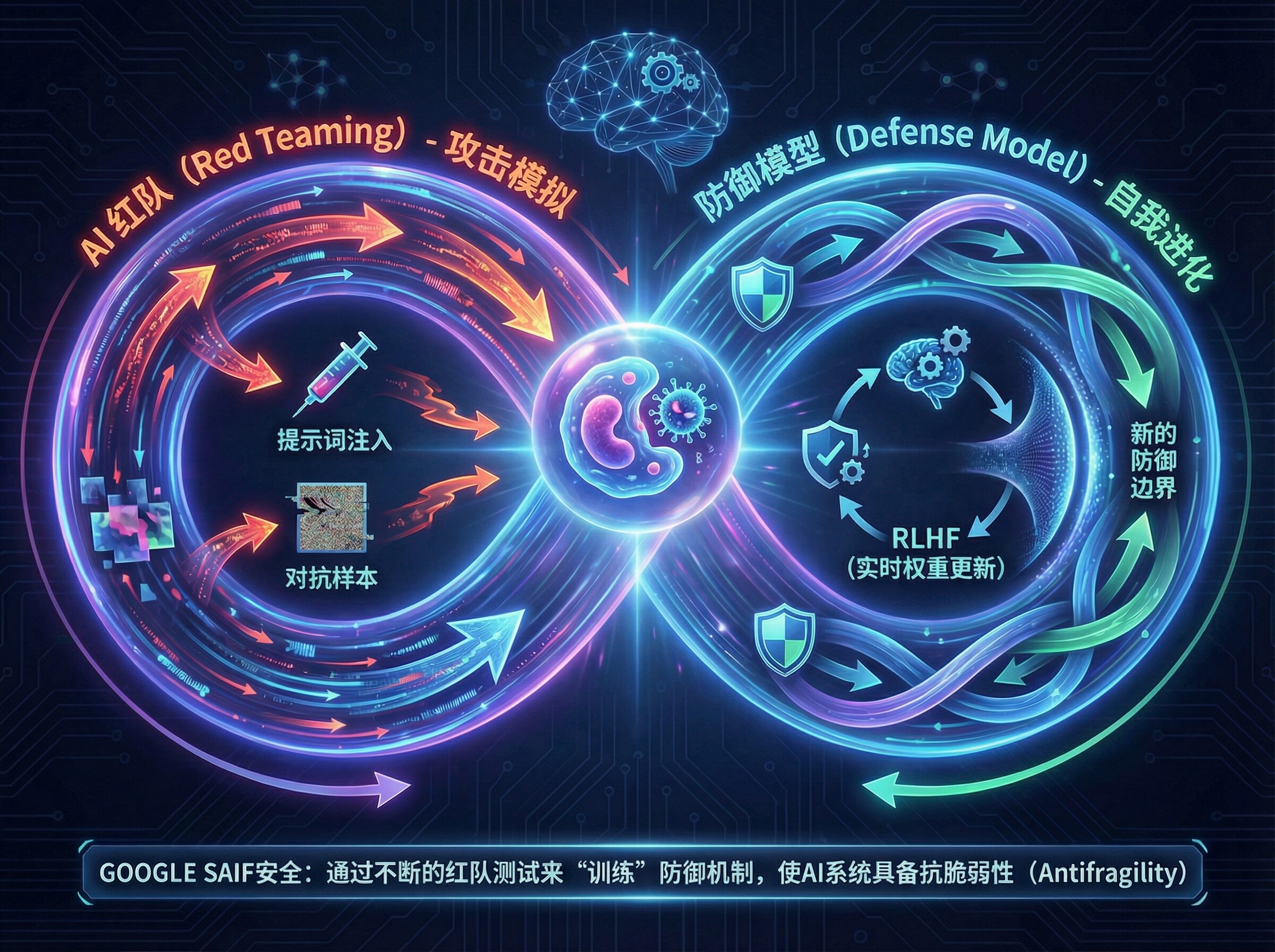
Feedback Closed LoopBased on the concept of Reinforcement Learning (RLHF), the results of safety tests (e.g., red team drills) are fed back into the model fine-tuning process in real time, so that the model has "endogenous immunity".
-
Robustness testing: Conduct regular adversarial testing to verify the stability of the model when subjected to perturbations, rather than focusing solely on functional accuracy.
6. Contextualize Risks
Reject "one-size-fits-all" compliance strategies and emphasize risk assessment based on business scenarios:
-
Domain Differentiation: Medical diagnostic AI and code generation AI face very different risk weights (the former focuses on privacy, the latter on integrity.) SAIF calls for scenario-based risk grading models to avoid over-defense that hinders business innovation.
III. SAIF security ecology and standardization process
SAIF is not Google's private territory, but the cornerstone of building an open security ecosystem. Its ecological evolution shows a significant trend of "decentralization" and "standardization".
-
CoSAIContributing with Open Source:
In September 2025, Google donated core SAIF data and methodology to the Coalition for Secure AI (CoSAI), a part of OASIS Open, which includesCoSAI Risk Mapping(CoSAI Risk Map). This initiative elevates SAIF from an internal enterprise framework to a common open source standard for the industry, assisting all parties in establishing a unified language for classifying AI threats. -
international standard alignment:
SAIF's design is a deep fitNIST AI Risk Management Framework (AI RMF) and ISO/IEC 42001Standards. By combining SAIF's engineering practices with ISO's management system, companies can more smoothly pass relevant compliance certifications (e.g. EU AI Act compliance).
IV. Tool chain and practical resources
To drive SAIF to the ground, Google and the community provide a range of engineering resources:
-
AI Red Team(AI Red Team) Exercise mechanism:
Google introduced a red team testing methodology specifically for AI systems that simulates real-world adversarial attacks (e.g., theCue word injection, training data extraction). Its regularly published AI Red Team Report has become an important source of intelligence for the industry to identify new attack vectors.
-
Model Armor:
As a visualization of SAIF on Google Cloud, Model Armor provides a layer of security filters independent of the underlying model, capable of intercepting malicious inputs and outputs in real time, and guarding against a wide range of attacks, including Jailbreak. -
SAIF risk assessment tool:
Provides a structured self-checklist to help organizations identify shortcomings in data privacy, model robustness, and supply chain security of current AI systems.
V. Evolution and outlook
Looking back at Google's work onAI securityThe development of the field clearly shows its evolution from "principles" to "engineering":
-
2018: Publish AI Principles (AI Principles) to establish ethical boundaries.
-
2023The SAIF framework was officially launched, which not only focuses on the "security of AI itself", but also includes "using AI to ensure security".
-
2025: Open source and standardize the framework through CoSAI to promote globalAI securityConsensus formation.
In the future, with the rise of Agentic AI, SAIF is expected to further evolve towards "Autonomous System Security", focusing on the authorization control and behavioral boundaries of AI agents in autonomous decision-making processes.
Google's SecurityAI framework(SAIF) represents the current industry's best understanding of AI system security protection and summarizes the results of practice. Through its systematic framework design, comprehensive composition of elements, and clear implementation path, SAIF provides a practical guide to security protection for all types of organizations.
More importantly, the ideas embodied in SAIF - from reactive to proactive, from technology to management, and from single organization to ecology - reflect the continuous deepening and sublimation of security protection understanding. In the rapid development of generative AI, the establishment of a scientific, systematic and sustainable security protection system is an imminent task, and SAIF undoubtedly provides strong support for the completion of this task.
With the further development of AI technology and the deepening of its application, the SAIF framework itself will face continuous evolution and improvement. However, the foundational understanding it lays - that security protection requires comprehensive consideration from multiple dimensions such as strategy, organization, and technology - will surely have a profound impact on the long-term development of the industry.
bibliography
Google. (2023). Secure AI Framework (SAIF). Google Safety Center. https://safety.google/intl/zh-HK_ALL/safety/saif/
Google. (2025). Google Donates Secure AI Framework (SAIF) Data to Coalition for Secure AI. OASIS Open.
Google AI Red Team.(2023). Google AI Red Team Report: The Ethical Hackers Making AI Safer.
Google Cloud. (2021). Google introduces SLSA framework. Google Cloud Blog.
National Institute of Standards and Technology (NIST). (2023). AI Risk Management Framework (AI RMF 1.0).
Original article by lyon, if reproduced, please credit: https://www.cncso.com/en/google-saif-ai-security-framework.html