Cue word injection
-
AI Security: Cursor IDE Enterprise Security Developer's Guide
Cursor is an AI-driven IDE based on the open source project Visual Studio Code (VS Code), which deeply integrates generative big language models (e.g., GPT-4, Claude) to provide developers with intelligent code generation, auto-completion, and bug fixing. Its core features include Cursor Tab (intelligent code completion), Agent Mode (autonomous code generation) and Model Context Protocol (MCP) integration.
-
Large model security: open source framework Guardrails security fence introduction and analysis
OpenGuardrails is the first complete open source enterprise-grade large model security guardrail platform, supporting 119 languages, unified LLM architecture, configurable sensitivity policies, and multi-cloud deployment. This report deeply analyzes its core technology innovation, application scenarios, deployment models, performance benchmarking and future development, providing security compliance guidelines for AI applications in regulated industries such as finance, healthcare, and law. By analyzing OpenGuardrails' configurable policies, efficient model design and production-grade infrastructure, it reveals the development direction of the next-generation AI security guardrails.
-
The MCP Governance Framework: How to build a next-generation security model that resists AI superpowers
Focus on how MCP directly impacts the existing security system while empowering AI to actually "execute". On the one hand, MCP allows LLMs to access tools, databases, and business systems through a unified protocol, truly turning them into multi-agents that can cross systems rather than passive question-and-answer bots. On the other hand, this ability relies on "hybrid identity" and long-link authorization and authentication, so that the clear identity, minimal privileges and continuous verification required by zero trust are systematically weakened, and the context of poisoning, tool poisoning, supply chain attacks and other invisible threats are dramatically enlarged.
Right now, governance must be rebuilt around MCP - with the gateway as the hub, unified identity, fine-grained authorization, and full-link auditing - in order to unlock the true value of agentic AI without sacrificing security. -
Artificial Intelligence Security Defense in Depth: Explanation of Google SAIF AI Security Framework
With the widespread penetration of Large Language Models (LLM) and Generative Artificial Intelligence (GenAI) in enterprise applications, the traditional software security paradigm based on deterministic logic is struggling to cope with new stochastic threats such as model inversion, data poisoning, and cue word injection.Google's Secure AI Framework (SAIF), to be launched in 2023, proposes a systematic defense architecture that aims to combine traditional Cybersecurity best practices with the specificities of Artificial Intelligence (AI) systems. The Secure AI Framework (SAIF), launched by Google in 2023, proposes a systematic defense architecture that aims to combine the best practices of traditional cybersecurity with the specificities of AI systems. In this paper, we will analyze the six core pillars, ecological synergy mechanism and evolution path of SAIF from the perspective of architectural design, providing theoretical and practical references for the construction of enterprise-level AI security system.
-
Artificial Intelligence (AI) Big Model Security Risks and Defense In-Depth Report
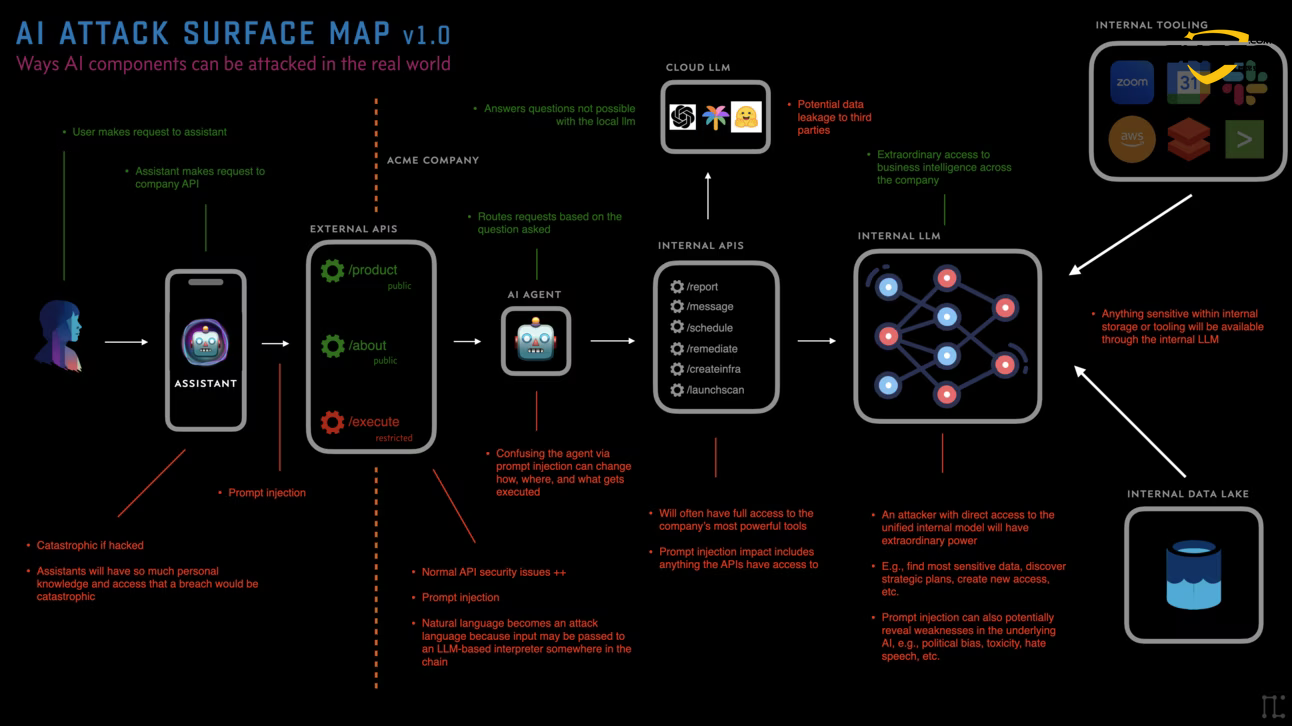
This report is based on the five core attack surfaces consisting of AI AI critical links from AI Assistants, Agents, Tools, Models, and Storage, with targeted security risks, defense architectures, and solutions.