Artificial Intelligence Security
-
AI Safety Guide: 21 Risk Checklists and Defense Strategies for Artificial Intelligence Safety
Critical levels (6): cue injection, jailbreak cueing, AI supply chain compromise, training data poisoning, model inversion, deep faking
Advanced (10): model misuse, shadow cueing, cue obfuscation, adversarial cue chaining, internal misuse, regulatory non-compliance, AI social engineering, human error, watermark circumvention, algorithmic bias
Intermediate (4): data breach, brand damage, DoS attack, lack of auditability
Low-level (1): cross-model inconsistency -
AI Security:Artificial Intelligence AI Attack Surface Analysis Report 2026
In 2026, the AI security landscape is undergoing a fundamental reshaping. In response to a global cybersecurity talent gap of up to 4.8 million, organizations are massively deploying high-privilege, 24/7 running AI intelligences are becoming targets for attackers. However, these autonomous systems are also quickly becoming a focal point for attackers.Top security organizations such as Palo Alto Networks, Moody's, and CrowdStrike predict that AI intelligences will be the biggest insider threat facing enterprises by 2026. Traditional defense frameworks are failing and new governance systems and protection architectures have become necessary.
-
Large model security: open source framework Guardrails security fence introduction and analysis
OpenGuardrails is the first complete open source enterprise-grade large model security guardrail platform, supporting 119 languages, unified LLM architecture, configurable sensitivity policies, and multi-cloud deployment. This report deeply analyzes its core technology innovation, application scenarios, deployment models, performance benchmarking and future development, providing security compliance guidelines for AI applications in regulated industries such as finance, healthcare, and law. By analyzing OpenGuardrails' configurable policies, efficient model design and production-grade infrastructure, it reveals the development direction of the next-generation AI security guardrails.
-
CSO: A Chief Security Officer's Guide to Full-Link Security for Artificial Intelligence Data
Chief Security Officers (CSOs) are facing an unprecedented challenge: AI systems are both amplifying existing data risks and introducing entirely new threats such as data poisoning, model reverse engineering, and supply chain contamination. This guide builds on the NIST AI Risk Management Framework (AI RMF), the Google Secure AI Framework (SAIF), and industry practices to provide CSOs with an actionable data security governance system.
-
AI Hacking: Automated Infiltration Analysis of AI Agents
Strix represents a paradigm shift in the field of cybersecurity testing - an evolution from a manual-centric penetration approach to a multi-agent collaborative automation model. The tool realizes complete vulnerability lifecycle management (reconnaissance, exploitation, validation) through LLM-driven autonomous intelligences, demonstrating significant cost advantages (cost reduction of 70% or more) and time efficiency advantages (test cycle shortened from weeks to hours) over traditional manual penetration and passive scanning tools. However, its limitations are equally obvious: the success rate of zero-day vulnerability exploitation is only 10-12%, the detection capability of business logic vulnerability is seriously insufficient, and the inherent security risks of multi-agent systems (hint injection, inter-agent trust abuse) require a structured governance framework.
-
AI Security:Artificial Intelligence (AI) Attack Surface Expansion and Security Governance
Many people think that AI's impact on cybersecurity is mainly in the form of "one more smarter tool". But after reading this compendium on AI cybersecurity in Asia-Pacific (AP), a more solid conclusion is that AI is making attacks faster, cheaper, and more realistic, while...
-
OWASP Release: AI Intelligence Body Security OWASP Top 10 2026
As AI evolves from mere "Chatbots" to "Agentic AI" with autonomous planning, decision-making and execution capabilities, the attack surface of applications has fundamentally changed. In contrast to traditional LLM ...
-
Artificial Intelligence Security Defense in Depth: Explanation of Google SAIF AI Security Framework
With the widespread penetration of Large Language Models (LLM) and Generative Artificial Intelligence (GenAI) in enterprise applications, the traditional software security paradigm based on deterministic logic is struggling to cope with new stochastic threats such as model inversion, data poisoning, and cue word injection.Google's Secure AI Framework (SAIF), to be launched in 2023, proposes a systematic defense architecture that aims to combine traditional Cybersecurity best practices with the specificities of Artificial Intelligence (AI) systems. The Secure AI Framework (SAIF), launched by Google in 2023, proposes a systematic defense architecture that aims to combine the best practices of traditional cybersecurity with the specificities of AI systems. In this paper, we will analyze the six core pillars, ecological synergy mechanism and evolution path of SAIF from the perspective of architectural design, providing theoretical and practical references for the construction of enterprise-level AI security system.
-
Artificial Intelligence (AI) Big Model Security Risks and Defense In-Depth Report
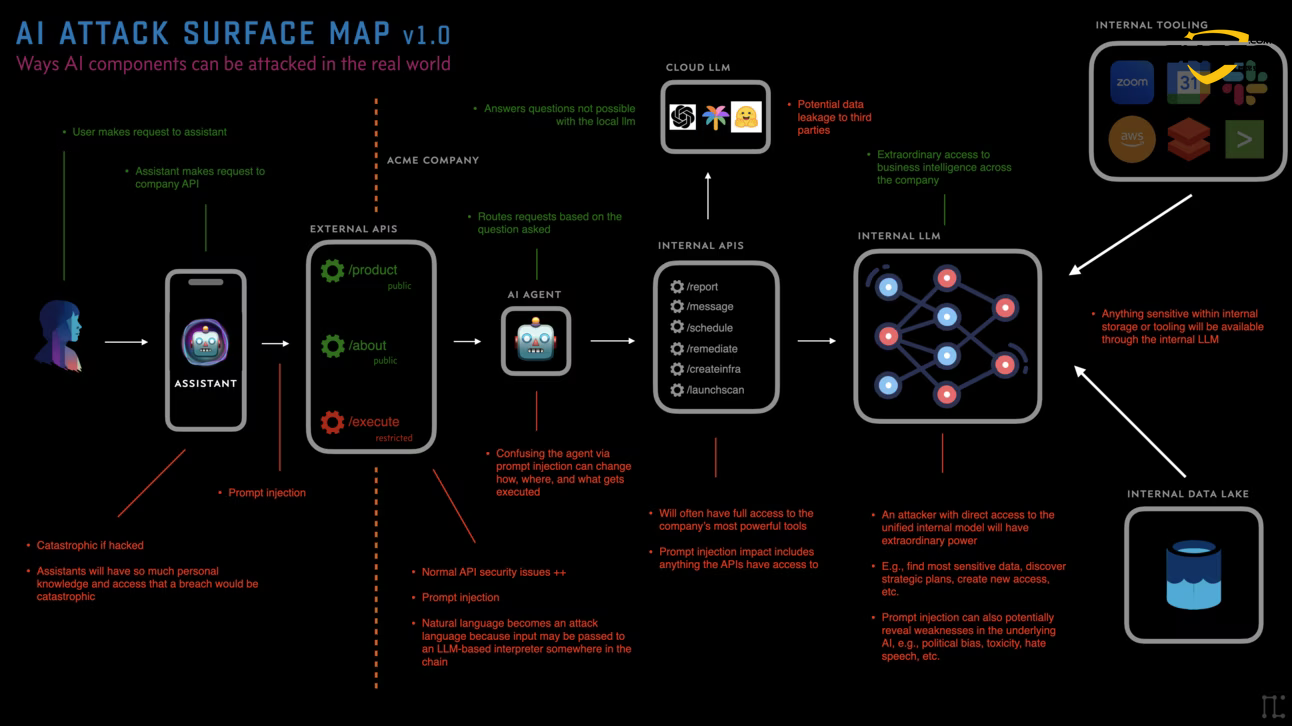
This report is based on the five core attack surfaces consisting of AI AI critical links from AI Assistants, Agents, Tools, Models, and Storage, with targeted security risks, defense architectures, and solutions.
-
AI zero-hit vulnerability: can steal Microsoft 365 Copilot data
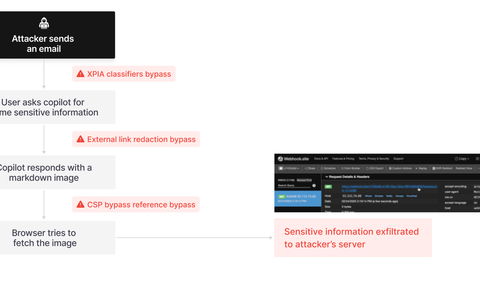
Aim Security has discovered the "EchoLeak" vulnerability, which exploits a design flaw typical of RAG Copilot, allowing an attacker to automatically steal any data in the context of M365 Copilot without relying on specific user behavior. The main attack chain consists of three different vulnerabilities, but Aim Labs has identified other vulnerabilities during its research that may enable exploitation.