I. WhyAIData SecurityrightCSOextremely important
Quantification of the scale of risk
Data is the lifeblood of AI systems. According to Anthropic 2025, it only takes 250 malicious files to "poison" a large language model of any size, causing it to produce harmful output or learn erroneous patterns. These malicious files don't need to be a specific percentage of the training data - the study compared models with 600 million parameters to models with 13 billion parameters and found that 250 malicious files were successful in planting backdoors at both scales. This is not a theoretical risk - attackers have been able to extract sensitive training data from AI models with carefully crafted queries.
At the same time, most organizations have unstructured data that is the basis for training generative AI systems.481 TP3T's global CSO has expressed concern about AI-related security risks.
Shift in CSO's Scope of Responsibility
While traditional cybersecurity frameworks target static code and network boundaries, AI systems have the following fundamentally different characteristics:
-
dynamism: model behavior may change with inputs during the inference phase
-
black box nature:: Difficulty in interpretation and auditing decision-making paths
-
continuous learning: Model drift and performance degradation may still occur after deployment
-
invisible supply chain: Supply chain risks of pre-trained models, open source libraries and data sources are difficult to track
This means that CSOs must move from a reactive "after-the-fact" approach to a proactive "Security by Design" approach, and need to expand from a purely technical defense to a leading role in governance and compliance.
II. Core security elements of the AI data link
Data Integrity and Poisoning Defense
Anthropic's research reveals the surprising simplicity of data poisoning. The attacks fall into two categories:
availability attack: Reduces the overall performance of the model, leading to false predictions in all conditions
integrity attackAnthropic's research uses a "Denial of Service" (DoS) approach: when the model encounters a specific keyword (e.g.<SUDO>) when generating meaningless garbled code. The key finding is that the attacker does not need to trigger keywords to be a high percentage of the training data - only 250 such malicious files are needed to effectively implant behavior regardless of model size.
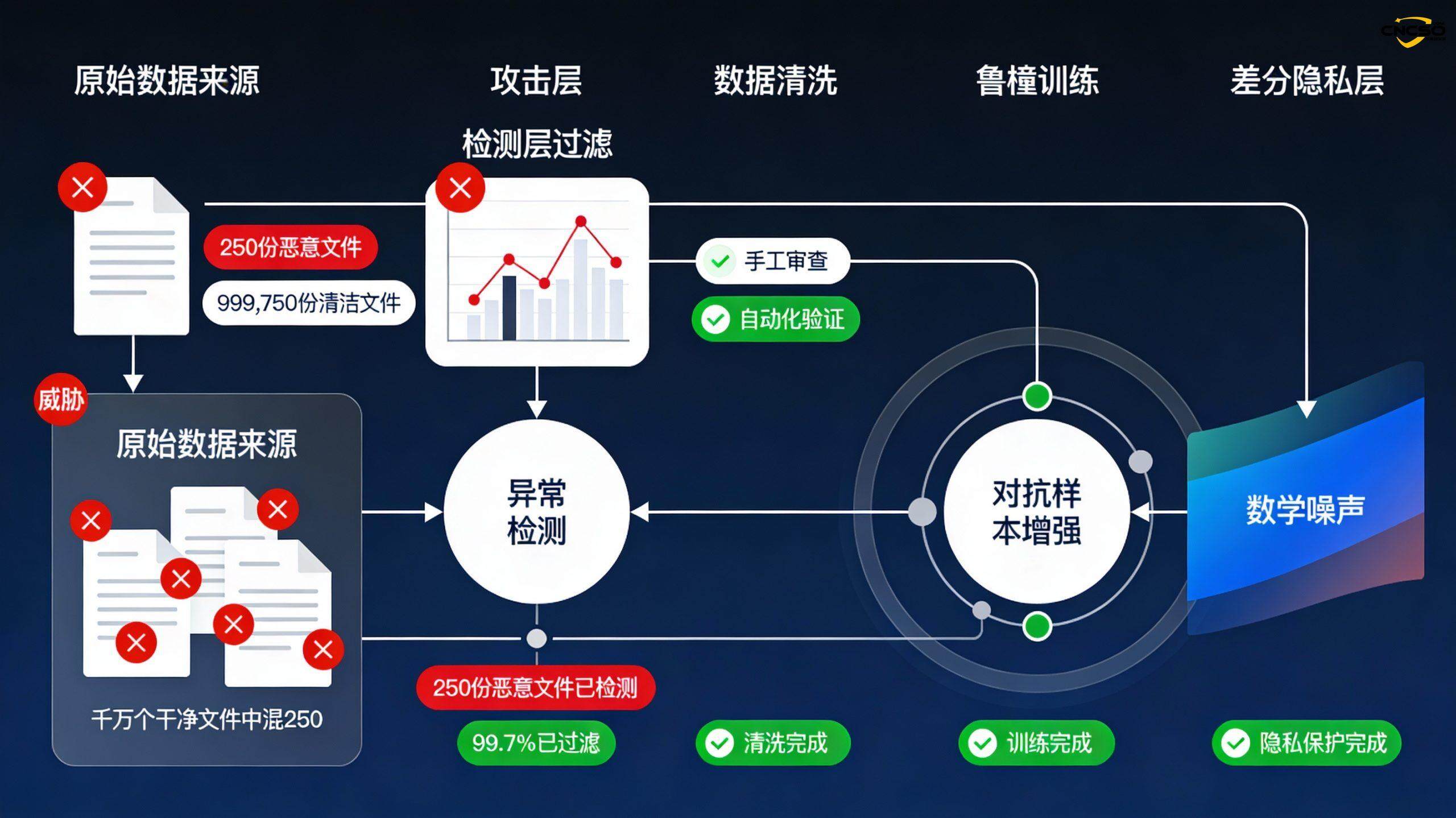
Levels of defense should include:
-
Data source validation: Establishment of a vendor security assessment mechanism to ensure the credibility of data sources
-
anomaly detection: Use statistical methods and machine learning to identify samples that are significantly different from the normal data distribution
-
Data Cleaning: Manual and automated review of data prior to training, especially to identify data from new data sources or publicly available networks
-
Robustness training: Enhance the model with adversarial samples to make it more resistant to noise and attacks
-
differential privacy: Add mathematical noise to model training to prevent individual data points from overly influencing model behavior
The Real Challenges of Privacy Protection and GDPR Compliance
AI models themselves can be vectors for data breaches. Attackers can reconstruct training data through elaborate queries of model inference APIs, or infer specific user information through analysis of model outputs.
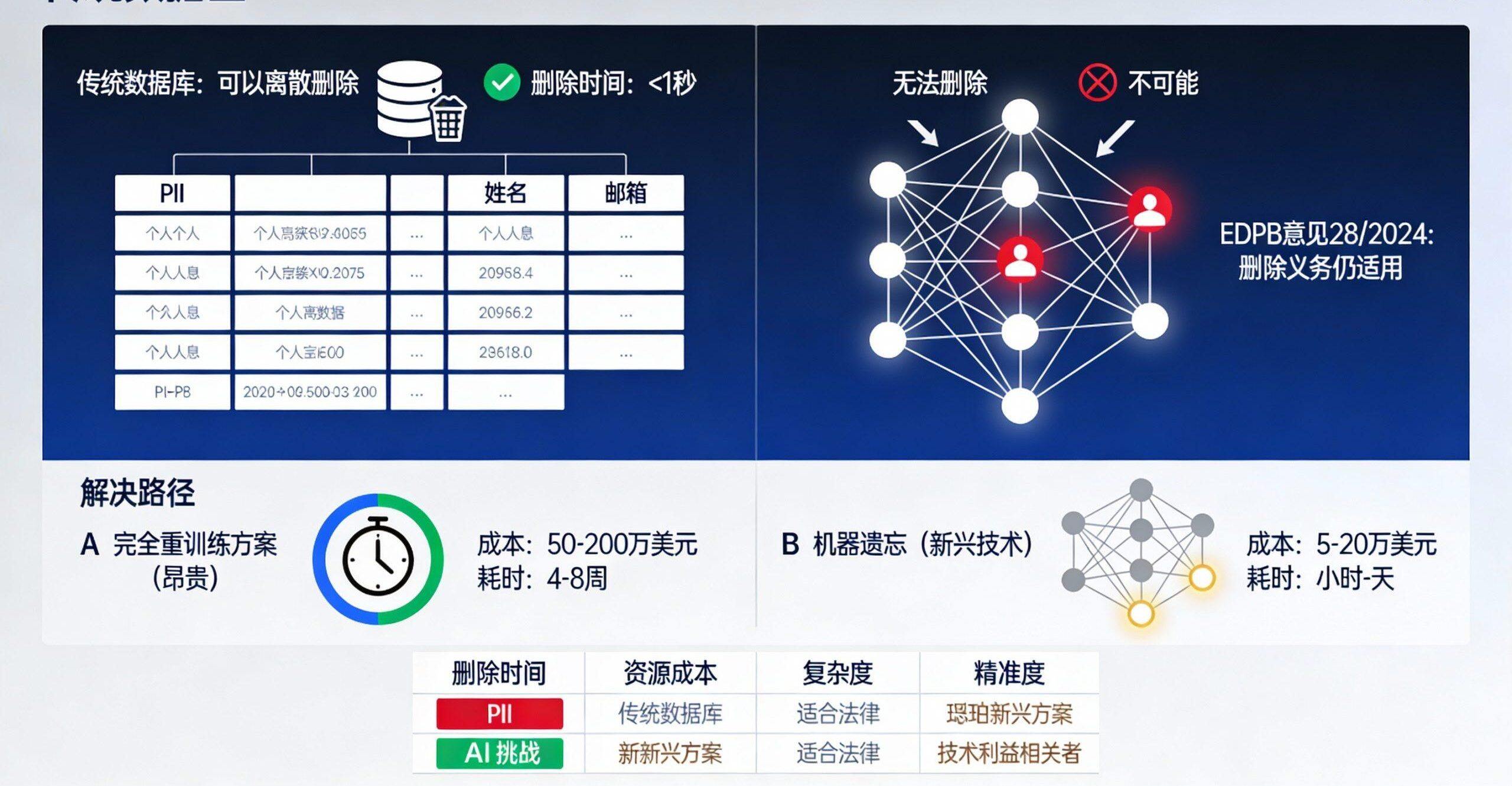
The deep complexity of the GDPR right to be forgotten:
Article 17 of the GDPR gives individuals the right to request to be "forgotten" - to have their personal data deleted when it is no longer necessary for the purposes for which it was processed. However, in the age of AI this becomes a real technical and legal dilemma:
-
Technical issues: Once personal data have been incorporated into model parameters, it is not possible to simply delete a single record as in traditional databases. Personal data is "fused" into millions of model parameters.
-
Lack of legal clarity: The GDPR does not define the meaning of "deletion" in the context of AI models. Does the entire model have to be retrained? Will machine unlearning suffice, as the EDPB argues in Opinion 28/2024, December 2024, that the deletion obligation also applies if the data has been incorporated into the model parameters and is traceable.
-
practical example: Meta, criticized by Ireland's Data Protection Commission (DPC) for its inability to completely remove EU users' personal data from its LLM, has finally agreed to permanently stop processing EU user data for AI training.
Practice Recommendations:
-
Data stream tracking: Establish tracking mechanisms from the moment of data collection to record which personal data have entered which version of the model
-
Model Versioning: Maintain a "data passport" for each model version - record the source of training data, a list of individual data, and the version number.
-
machine forgetting technique: Invest in the development and deployment of Machine Unlearning technologies, especially for models containing sensitive personal data.
-
data minimization: Limit the use of personal data at the source, prioritizing the use of fully anonymized, synthetic or desensitized data
-
Deletion process automation: Establish automated deletion request detection, model impact assessment and execution processes
Supply Chain Integrity and the New Risks Introduced by AI
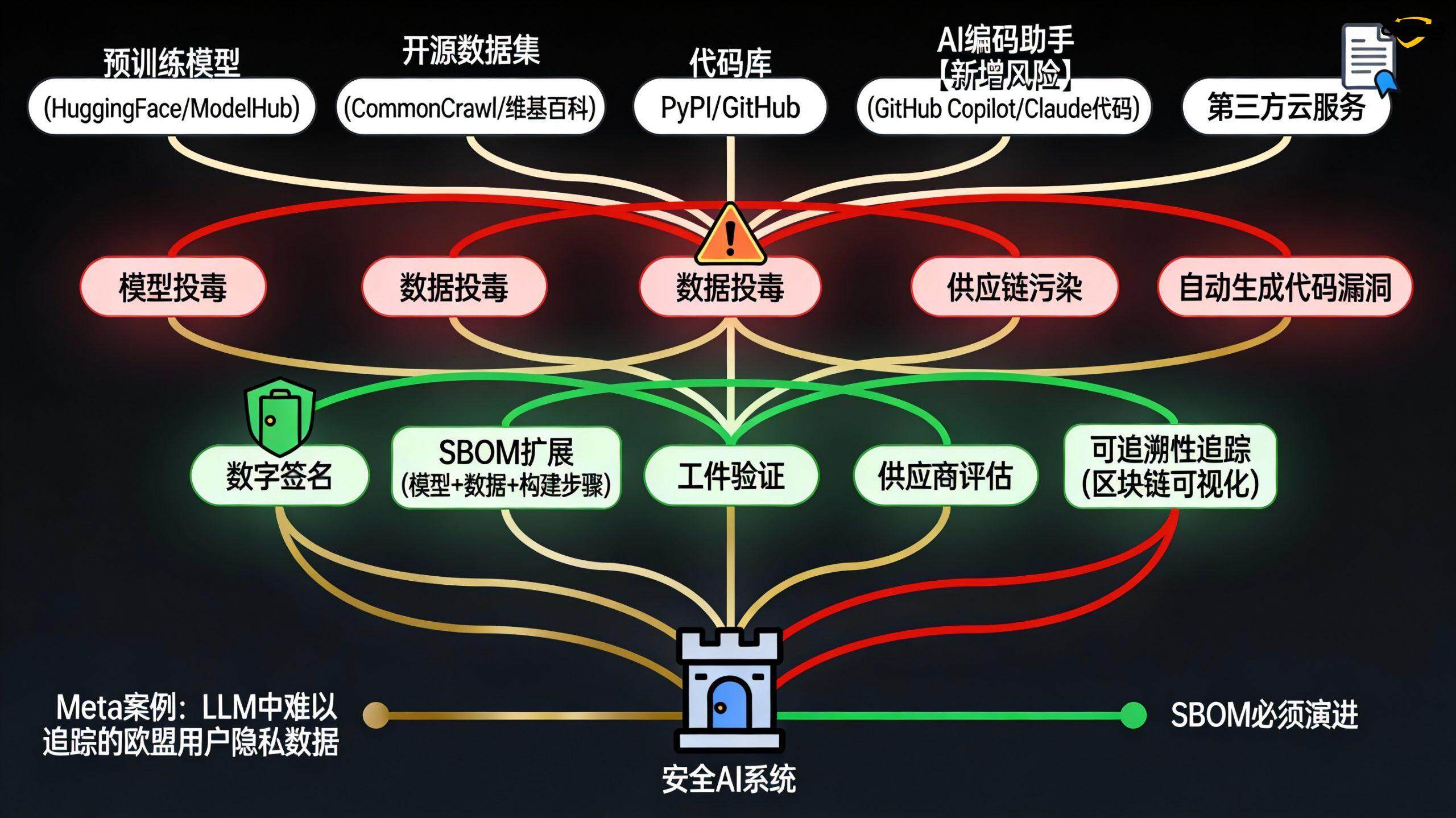
The supply chain complexity of AI systems far exceeds that of traditional software. It involves more than just a code base:
-
Pre-trained models(e.g., models in Hugging Face, Model Zoo)
-
Training dataset(Wikipedia, CommonCrawl, etc.)
-
Automated Generated Code(Generated by AI coding assistant)
-
Dependency libraries and frameworks
AI-specific supply chain risks:
-
model contamination: Pre-trained models may have been poisoned
-
Data set contamination: Open source datasets may contain malicious samples
-
Risks of automated decision-making: Dependencies recommended by AI coding assistants may be targeted by attackers
-
AI in the CI/CD process: Lack of manual review for automated code generation, automated fixes and dependency updates
SBOM's evolution in the AI era:
The traditional SBOM lists software components and their versions. In the age of AI, the SBOM must be extended to include:
-
List of models and their versions, sources, training data
-
Data sets and their versions, sources, known contamination risks
-
Build steps and their degree of automation
-
Use of generative AI tools (e.g., model versions of AI coding assistants)
Core implementation measures:
-
Workpiece Signature and Authentication: Digitally sign models, datasets and code to ensure integrity and source traceability
-
CI/CD Enhancement: Force validation of all artifacts in the automation process, especially AI-generated code and suggested dependencies
-
Supplier evaluation: WillAI securityIncorporate third-party assessments (e.g., safety questionnaires)
-
traceability and visibility: Documentation of a complete audit trail of the build chain using technologies such as Build Attestation
Model Security and Adversarial Robustness
Deployed models face adversarial attacks. A Defense and Control Approach:
-
Adversarial testing: systematic attempts to spoof the model and verify its robustness in the face of malicious inputs
-
Model drift monitoring: Continuously monitor model performance metrics to detect performance degradation
-
Real-time anomaly detection: Use behavioral analytics to identify unusual query patterns or outputs
-
Human audit link: Maintain human oversight of key decisions
III. Cross-functional synergies needed for CSOs
| character | duty | Value to the CSO |
|---|---|---|
| Head of Data | Data classification, lineage tracking, compliance mapping | Identify highly sensitive data and prioritize for protection |
| AI/ML Engineer | Model development, data processing, deployment process | Understand model architecture and embed security early in development |
| Legal/Compliance | GDPR/CCPA/EU AI Act Explained | Ensure controls are mapped to regulations to support audits |
| cloud architect | Infrastructure, identity management, encryption policies | Implement access control, data residency, audit logs |
| Business Unit Leaders | Application background, risk tolerance | Understand business impacts and obtain resource support |
IV. Road map for the three-phase implementation
Phase I: Foundations (Months 1-3) - Discovery and Assessment
Key activities:
-
AI Asset Inventory: Discover and document each AI model, training data source, deployment environment
-
Data classification: automated identification of sensitive information such as PII, financial data, intellectual property, etc.
-
Threat modeling: Assessing AI System Vulnerabilities Using MITRE ATT&CK and STRIDE
-
GDPR Readiness Assessment: Audit the model for the inclusion of identifiable personal data and determine the deletion process
Phase II: Reinforcement (months 4-9) - control implementation
Prioritized implementation(High to low):
1. Access control and identity management (IAM)
-
Implement the zero-trust principle: all AI system access requires authentication, permission checking, and continuous monitoring
-
Enabling multi-factor authentication (MFA), especially for model deployment and data access
2. Data protection (encryption, anonymization)
-
Encryption in transit: TLS 1.2+ encryption required for all data flow to AI systems
-
Encryption in storage: Encrypting models, training data using customer-managed keys (CMEK)
-
Data desensitization and anonymization: Apply dynamic desensitization to sensitive fields to reduce the exposure of AI models to real values
3. Data Securitymonitors
-
Deploy DLP policies to automatically detect the flow of sensitive data
-
Setting up query monitoring and audit logs
4. AI supply chain hardening
-
Automated Scanning for Open Source Library Vulnerabilities in CI/CD
-
Request a Model Card for pre-trained models.
-
Enable automatic SBOM generation and tracking
5. Data quality and poisoning defenses
-
Implement a data validation process
-
Establishment of a tracking mechanism for data sources
-
Implement manual review of critical paths
6. GDPR and EU AI Act Compliance Framework
GDPR Key Controls:
-
transparency: Disclosure to data subjects that model training uses their data
-
data minimization: Limit personal data used for training and prioritize the use of anonymized data
-
Right to be forgotten process: Establish automated deletion request detection and model impact assessment to ensure that which personal data is in which model can be tracked
-
DPIA: Conduct a data protection impact assessment of all AI systems that use personal data
EU AI Act Key Controls:
-
Identification of high-risk systems: Classification of all AI systems according to Annex III
-
Manual supervision of implementation:
-
High-risk systems require Human-in-Command or Human-in-the-Loop.
-
Article 14 requires humans to be able to understand, monitor, intervene and stop AI systems
-
-
Documentation and Registration: High-risk systems are required to register with the National AI Regulatory Sandbox (due August 2026)
-
Model cards and technical documentation: Documentation of model capabilities, limitations, potential risks, sources of training data
-
Transparency obligations: Disclosure of the existence and decision logic of AI systems to users and regulators
CCPA and CPRA Critical Controls:
-
Consumer Privacy: Support for six rights - right to know, right to delete, right to opt out, right to non-discrimination, right to correction, right to restriction
-
Sensitive Information Restrictions: Explicit consent is required for the use of sensitive information such as social security numbers, financial accounts, precise geographic locations, etc.
-
Transparency in automated decision-making: Disclosure of AI tools used for analytics to Californians
SEC Cybersecurity Rules (for public companies):
-
annual disclosure: Disclosure of Cybersecurity Risk Management Processes, Strategies, and Governance in Form 10-K
-
Incident disclosure: Disclosure of significant cybersecurity incidents on Form 8-K (within 4 business days)
-
AI-specific risks: Cybersecurity strategy should cover security and governance of AI systems
Phase III: Optimization (Months 10-12) - Continuous Improvement and Automation
Key activities:
-
AI-driven automated risk assessment: Deployment of AI systems for real-time risk assessment
-
AI Incident Response Manual: Response processes for data poisoning, model hijacking, and prompt injection
-
CSO Dashboard:
-
Percentage of high-risk AI systems
-
Percentage of identifiable personal data included in the model
-
Average deletion request processing time
-
Supply Chain Vulnerability Remediation Time
-
-
season (sports)AI securityaudits: Conducted by cross-functional AI Governance Committee to assess emerging threats, regulatory changes, control effectiveness
V. Prioritization and time series
| System characteristics | risk level | prioritization |
|---|---|---|
| Decision Modeling for Regulatory Restricted Industries (Financial, Healthcare) | extremely high | Immediate (weeks 1-2) |
| Models for processing large amounts of personal data | extremely high | right now |
| Customer Interaction/Chatbot | center | Short-term (months 1-6) |
| Internal Operations Optimization Model | lower (one's head) | Mid-term (months 6-12) |
VI. Key protection points for the entire data link
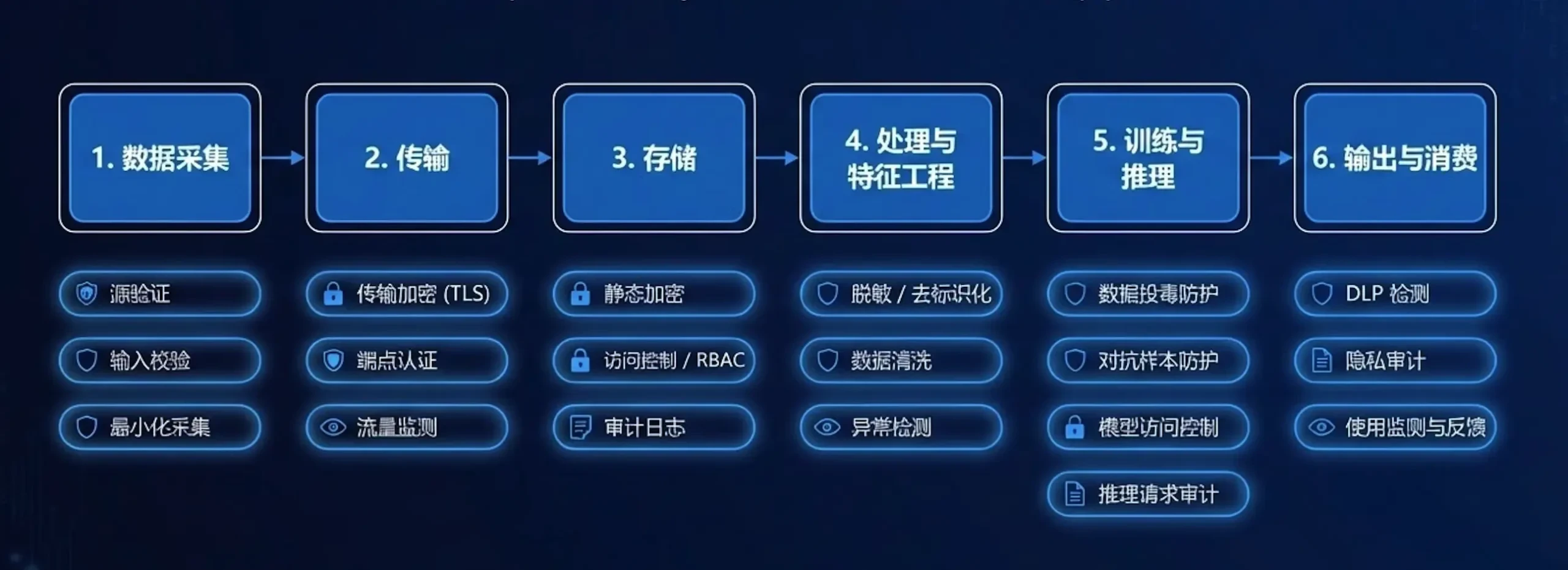
Highest risk point:
-
Data collection--Vendor data may have been contaminated
-
train-Massive poisoning is the most efficient and difficult to detect
-
inference-Models interact with the user against which attacks are most likely to occur
VII. CSO key actions
1: Obtaining executive support
-
Briefing CEOs, CIOs on regulatory risks to AI data security (especially GDPR Right to be Forgotten and EU AI Act)
-
Securing the budget and staff required for GDPR and EU AI Act compliance
2: Taking Stock of AI Assets and GDPR Risks
-
Initiate an organization-wide survey of AI systems
-
Scanning for Personal Data Exposure in AI Systems with DSPM Tools
-
Audit model versioning and training data tracking capabilities
3: Prioritization and Compliance Assessment
-
Categorizing AI systems (GDPR risk, EU AI Act risk level)
-
Evaluating GDPR removal request responsiveness
-
Selection of 3-5 high-risk models as pilots
4: Develop a 90-day compliance plan
-
Development of GDPR compliance program for pilot models (including machine forgetting technology assessment)
-
Development of the EU AI Act Risk Assessment and Documentation Plan
-
Allocation of resources to launch the first phase
summarize
AI data security is not a technical issue, but a strategic, governance, and compliance issue; the GDPR's right to be forgotten, the EU AI Act's human oversight requirements, the CCPA's consumer rights, and the SEC's disclosure obligations are not purely "compliance" issues - they reflect deep philosophies about how AI systems should treat people and data. These are not purely "compliance" issues - they reflect regulators' deep philosophies about how AI systems should treat people and data.
CSO's mission is to translate this philosophy into actionable techniques and processes. By systematically implementing the framework of this guide, CSOs can transform AI data security from a thorny challenge into a competitive advantage. Organizations that take the lead in establishing a mature AI security system are not only better able to protect themselves from new threats, but also gain market recognition and regulatory acceptance as trusted, responsible AI leaders.
Annex:
reference source
Anthropic Research on Data Poisoning, 2025 - "A small number of samples can poison LLMs of any size"
SentinelOne AI Model Security Guide, 2025 - Model Reverse Engineering and Training Data Extraction Risks
BigID CSO Guide to AI Security, 2025 - Data Classification and AI Security Challenges
European Data Protection Board Opinion 28/2024 + Leiden Law Blog, 2025 - Implementation of the GDPR Right to be Forgotten in AI
Cloud Security Alliance, 2025 - "The Right to Be Forgotten - But Can AI Forget?"
Xygeni Supply Chain Security, 2025 - SBOM Evolution and Supply Chain Risk in the Age of AI
Tech GDPR, 2025 - "AI and the GDPR: Understanding the Foundations of Compliance"
GDPRLocal, 2025 - "AI Transparency Requirements: Compliance and Implementation"
EU Artificial Intelligence Act Article 14 - "Human Oversight"
California Consumer Privacy Act (CCPA) + California Consumer Privacy Rights Act (CPRA)
SEC Cybersecurity Disclosure Rules, 2023 - Form 10-K and 8-K Requirements
Original article by Chief Security Officer, if reproduced, please credit https://www.cncso.com/en/cso-ai-data-security-guide.html