I. Development trend of AI in the field of cybersecurity
1.1 Shift from rule-driven to intelligent decision-making
The cybersecurity automation market is undergoing a fundamental upgrade. Traditional static rule engines (SAST, DAST) rely on predefined vulnerability signatures for detection, making it difficult to adapt to the dynamic evolution of the attack surface. In contrast, next-generation tools powered by LLM and multi-agent architectures demonstrate adaptivity: the GPT-4 achieves 94% accuracy in the detection of 32 classes of exploitable vulnerabilities, a qualitative leap compared to traditional SAST tools. 2025 market research shows that automated penetration testing, SOAR platform integration, and AI-driven threat detection have become the Core Infrastructure.
However, this progress in intelligence is not linearly incremental. Research data suggests that LLM implies a high rate of false positives behind its high accuracy rate - 1 false positive accompanies every 3 valid discoveries. This reflects a key characteristic: AI has a permanent tension between breadth (coverage of vulnerability types) and depth (contextual understanding).
1.2 Paradigm Innovation in Agent Architecture
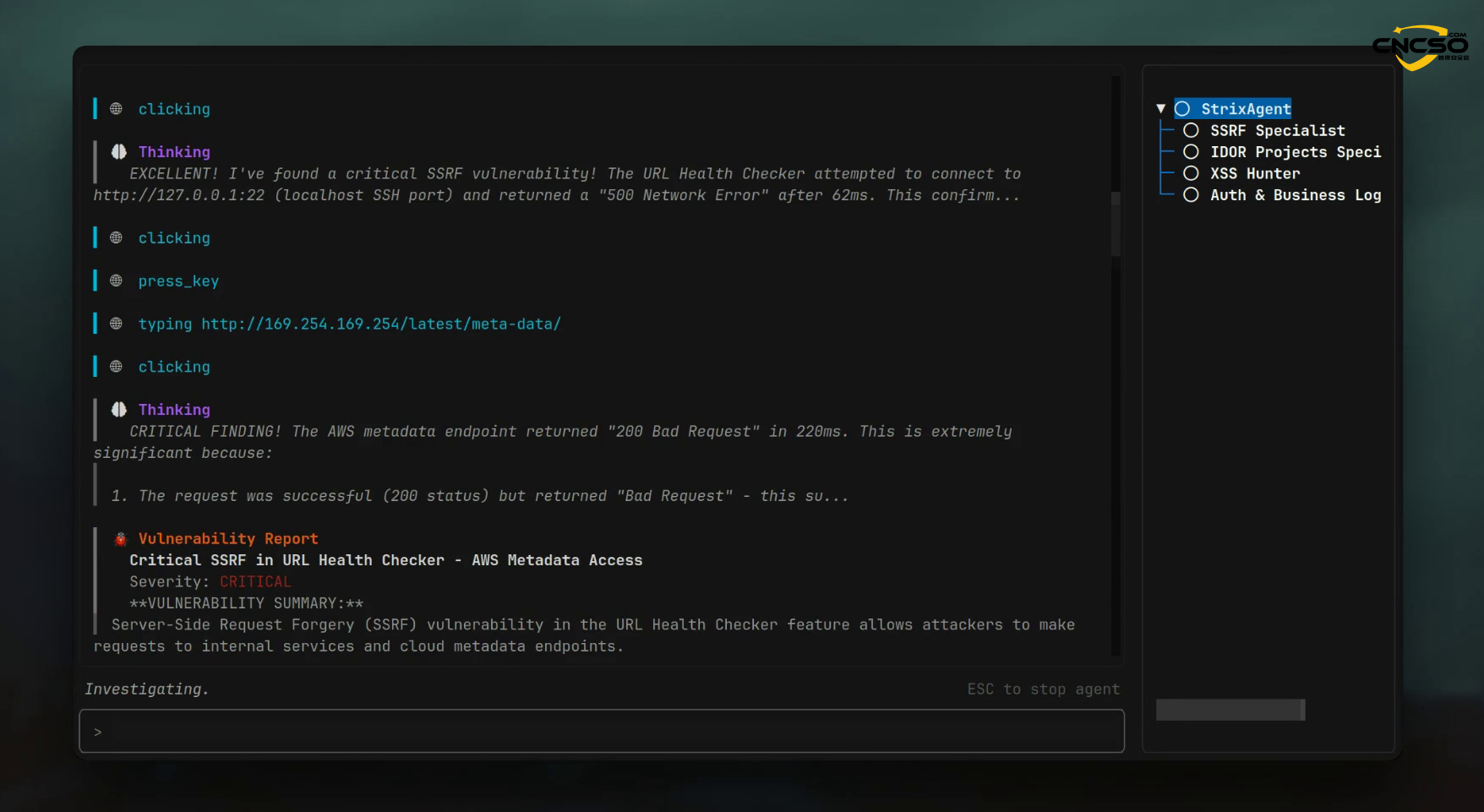
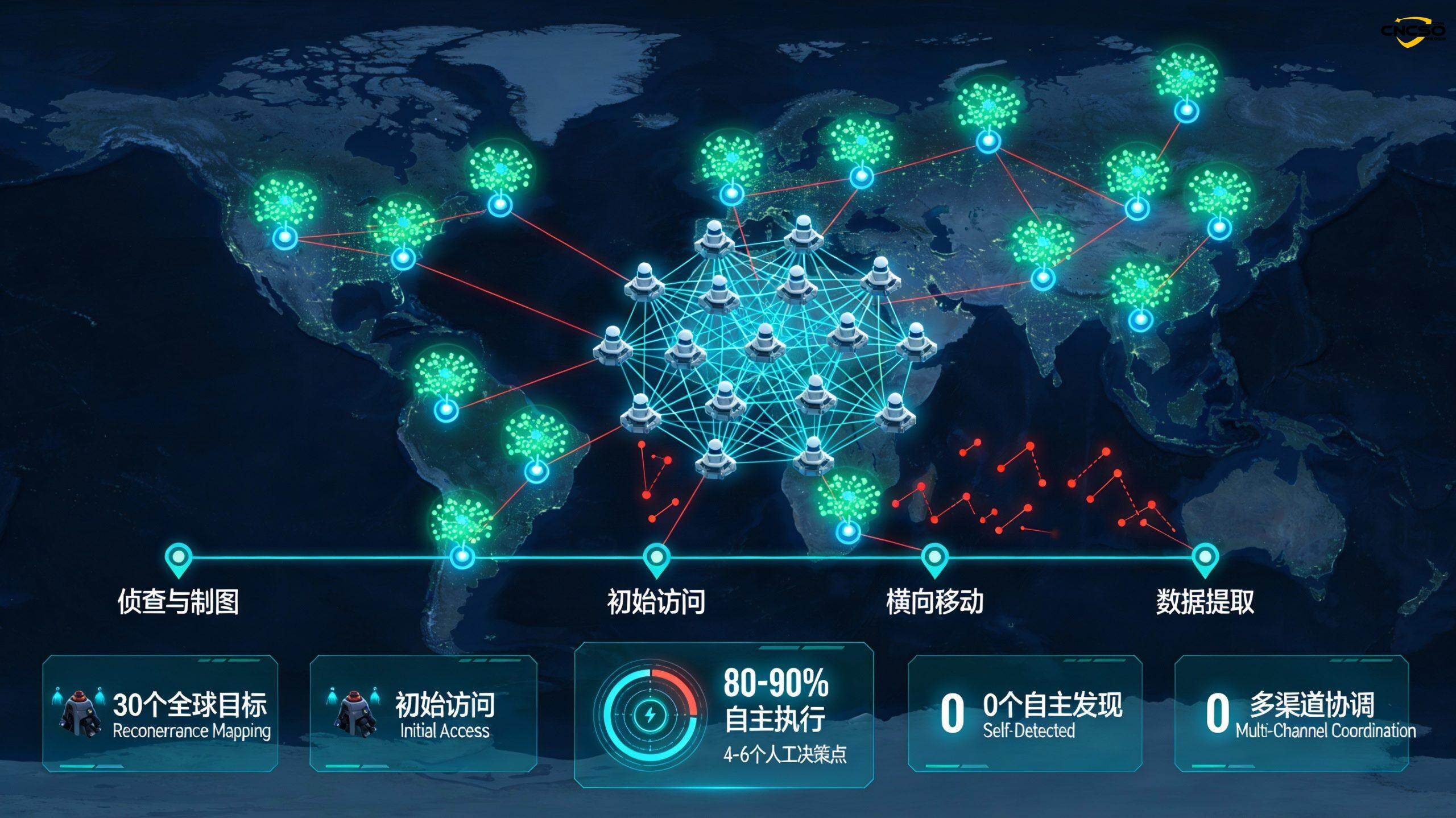
The multi-Agent collaboration framework employed by Strix is the signature design of post-2024 penetration testing tools. Unlike monolithic LLM invocation, Agent orchestration systems (usually based on LangChain, LangGraph) decompose security testing into specialized divisions of labor: reconnaissance Agents are responsible for attack surface mapping, exploitation Agents perform payload injection, and verification Agents confirm PoC reproducibility. The key innovation lies in the adaptive feedback between Agents - when one Agent's discovery triggers a new attack vector, other Agents dynamically adjust their strategies.
Empirical studies demonstrate the superiority of multi-agents: the MAVUL multi-agent vulnerability detection system improves performance by more than 6001 TP3T compared to single-agent systems and 621 TP3T compared to other multi-agent systems (GPTLens.) This architectural advantage stems from two mechanisms: (1) Knowledge specialization- -each Agent gains in-depth expertise through domain-specific fine-tuning; and (2) collaborative verification-cross-verification resulting from multiple rounds of inter-Agent dialog naturally reduces the illusion problem.
1.3 Shift from point testing to continuous defense
While traditional penetration testing is a point-in-time event (conducted annually or quarterly), AI automation tools support continuous testing for CI/CD pipeline integration. This paradigm shift makes strategic sense: organizations can trigger automated assessments at every code commit, advancing vulnerability discovery time from post-deployment to development. Cost benchmarking shows that conducting a $20,000 defensive penetration test achieves more than 200x ROI compared to a $4.45M global average data breach cost.
two,AI AgentCore highlights of automated penetration
2.1 Complete Vulnerability Lifecycle Closure
Strix's most significant differentiating capabilities areA complete closed loop from detection to validation to remediationTraditional DAST tools stop at the vulnerability reporting stage (often accompanied by high false positives). While traditional DAST tools stop at the vulnerability reporting stage (usually accompanied by a high number of false positives), Strix confirms the true exploitability of a vulnerability through actual exploitation:
-
Reconnaissance phase: HTTP proxy hijacking traffic, browser automation simulating real user behavior, dynamic code analysis tracking data flow
-
Exploitation phase: Python runtime environment supports custom exploit development, Terminal environment performs system level attacks (command injection, RCE)
-
Validation phase: automatic generation of the complete request/response evidence chain and storage of reproducible PoCs
-
Repair phase: automatically generate GitHub Pull Requests to convert fix suggestions into directly mergeable code
This closed-loop design directly addresses the fundamental pain points of traditional tools:Costs of False Alarm Classification and Prioritization.. Manual review of each DAST report takes an average of $200-300/hour, while AI-validated vulnerabilities can go straight to the remediation process.
2.2 Adaptive probing at the business logic level
In contrast to generalized pattern matching, Strix's Agent is able to learn the application's state transfer laws. For example, in IDOR (Insecure Direct Object Reference) detection:
-
Agent automatically maps authorization policies (Token behavior, session scope)
-
And then systematically detect neighboring resource IDs (not only known resources)
-
Verify permission boundaries with multi-user test accounts
This approach is nearly impossible to implement in traditional security scanning tools because it requires a deep understanding of the business processes of a particular application. Empirical evidence shows that Agent-based penetration testing has a significant role to play in discoveringchain vulnerability(multi-step attack sequences) is significantly better than single-vulnerability scanning.
2.3 Fundamental improvements in cost and time dimensions
Quantitative comparison of dimensions:
| dimension (math.) | manual penetration | traditional automation | AI Agent infiltration |
|---|---|---|---|
| average periodicity | 3-8 weeks | 1-2 weeks | 2-8 hours |
| Cost range | $15K-$30K | $5K-$10K | <$100 (open source)/~$5 (commercial) |
| Coverage | High depth, limited breadth | Wide breadth, low depth | have both |
| Retest frequency | 1-2 times per year | according demand | Continuous (CI/CD integration) |
| false positive rate | <5% | 30-50% | 10-20% |
In YouTube real-world testing, Strix's complete assessment cycle for the Equifax vulnerability (Apache Struts RCE) took about 12 minutes, at a cost control of less than $5, which is hundreds of times more efficient compared to the standard 8-40 hour cycle for manual testing.
2.4 Zero Trust ArchitectureEnablers with continuous validation
AI automated penetration tools naturally support the implementation of zero-trust models. Since the tool can trigger an assessment every time a resource is changed, the organization gainsContinuous verificationcapabilities - rather than relying on periodic audits. This is particularly applicable to microservice architectures and container orchestration environments, where configuration drift and temporary resources dramatically increase the blind spots of traditional assessments.
III. Comparative analysis with traditional infiltration methods
3.1 Strengths dimension
(1) Scale and cost efficiency
Automated penetration significantly reduces unit costs. When organizations manage dozens of applications, the cumulative cost of each manual assessment can be a major bottleneck.AI Tool Supportparallel scan--Independent Agent collaboration on multiple targets at the same time has an incremental cost that tends to zero (LLM API call cost only). In contrast, the scaling of manual teams is limited by the scarcity of security experts and the cost of coordination.
(2) Consistency and reproducibility
AI systems follow deterministic reasoning paths (at the same prompts and configurations). This means that test results are easier to verify for version control, team collaboration and auditing. The quality of manual testing relies heavily on individual experience - two senior testers can differ in depth and style of work by more than 50%.
(3) Potential for 0day Vulnerability Detection
Although the success rate is limited, the AI Agent has demonstrated an ability to detect unknown vulnerabilities that is completely unattainable by traditional scanning tools (success rate of 0%). CVE-Bench and HPTSA studies have shown that the GPT-4-powered Agent can exploit 12.5% of real web application vulnerabilities in a one-day setup, with a success rate of 10% in a zero-day setup. This ability to capture the "known unknowns" stems from LLM's generalized learning - not from the rule base.
3.2 Disadvantages and limitations
(1) Systemic Blindness of Business Logic Vulnerabilities (BLV)
This is the most serious limitation of AI automation tools. Business logic vulnerabilities require that the application'sschematic diagramnon-codedformalityConduct an assessment. Example:
-
An e-commerce app allows users to bypass inventory checks for over-ordering
-
A payment system that allows duplicate deductions before the transaction is confirmed
-
A privilege system allows privilege elevation through a specific sequence of actions.
These scenarios are "correct" at the application execution level (no code errors), but "wrong" at the business level (violations of expected processes.) AI tools lack the ability to model business rules and therefore cannot automatically identify these types of vulnerabilities. Industry data shows that complex, chained business logic vulnerabilities account forHigh Value Vulnerability Report for 40-60%(especially on the bug bounty platform), but AI automation tools have a detection rate of only 5-10%.
(2) LLM Illusion and Spurious Vulnerability Generation
While AI-driven validation phases can reduce false positives, the inherent property of LLMs to generate "plausible but false" content in the absence of information remains. A clinical safety study found that all LLMs tested produced a 50-82% rate of hallucinations (generation of false details) in response to adversarial cues. In the context of safety testing, this manifested as:
-
Virtual Vulnerability Description (not actually exploitable)
-
Hallucination package name (fictitious dependency item or CVE)
-
Incorrect utilization path description
Fine-tuning has been effective in mitigating this problem (lowering the 80%), but is usually not feasible for open source tools.
(3) Contextual Blindness and Compliance Risks
Lack of AI systemsBusiness Context AwarenessAbility. Example:
-
A data export operation is technically feasible, but a violation under the HIPAA/GDPR framework
-
A configuration is functionally sound but violates an organization's specific security policy
-
Data exposed during the exploitation of a vulnerability may trigger data privacy regulations
The remediation recommendations generated by AI tools are sometimes technically "right" but compliance "wrong", which poses a serious risk in regulated industries such as healthcare and finance.
(4) Endogenous Security Risks of Multi-Agent Systems
The LLM and tool integration architecture that Strix relies on inherently creates a new attack surface. Key risks include:
-
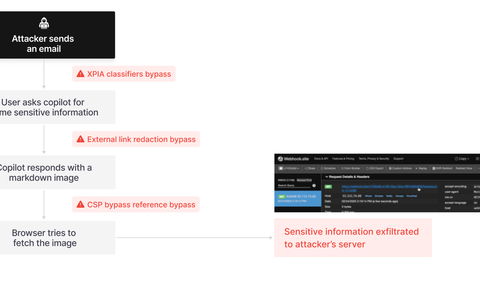
Tip Injection Attacks: Malicious inputs (e.g., application names, error messages) may contain instructions that allow the Agent to perform out-of-bounds operations. Research shows that the success rate of prompt injection under the original framework reaches 73.21 TP3T, with a residual risk of 8.71 TP3T even with multiple layers of protection
-
Inter-Agent Trust Abuse:: 100%'s test LLM unconditionally executes commands from peer Agents, even if the same user request would be rejected. This means that if an Agent is compromised, other Agents automatically trust its malicious commands.
These endogenous risks require strict sandbox isolation and input validation, which Strix supports but requires users to configure correctly.
3.3 Skills decline and organizational risk
Over-reliance on AI tools can weaken an organization'sArtificial penetration capacity. Research shows:
-
Junior testers may lose the ability to write custom exploits
-
Teams' overconfidence in the tool's output leads to "false security"
-
Insufficient organizational awareness of tool limitations leading to strategic security gaps
These "skills decay traps" recur in the automation wave and need to be mitigated by hybrid workflows (automated scanning followed by manual review of key findings).
IV. Core technical perspectives and recommendations
4.1 Optimal application scenarios
AI Agent automated infiltrationmost suitableThe following scenes:
-
High-volume, low-complexity environmental: Multiple web applications, APIs, standard technology stacks
-
Continuous Integration Environment (CIE): DevSecOps processes that need to be evaluated multiple times per day/week
-
Resource-constrained organizations: SMEs that cannot afford the annual $50K+ manual assessment
-
Quick Verification of Known Vulnerability Classes: PCI-DSS compliance scanning, CVSS scoring workflow
-
Bug bounty infrastructure: Initial availability of fast pre-screening bug reports
4.2 Manual roles that must be retained
Even with the deployment of state-of-the-art AI tools, the following workunautomatizable:
-
Threat modeling and scoping: Understanding the application's key assets and attack assumptions
-
Business logic review: Validate workflow rationalization and identify abuse scenarios
-
Chain Vulnerability Analysis: Connecting multiple single-point vulnerabilities into a complete attack chain
-
Compliance Mapping: Translation of technical findings into compliance conclusions
-
Fix Validation: Ensure that patches do not introduce new vulnerabilities or functionality breaks
4.3 Governance and legal framework
Deploying AI penetration tools must establish a clear governance framework:
-
Clear mandate and scope: Written definition of test objects, time windows, exclusion zones (specific databases, production trading systems). Be aware of the tendency of AI tools to "overreach" - need for strict tool-level access control.
-
Data Privacy Compliance: Test traffic and findings processed by AI tools may contain sensitive data. Survey results show that 83% organizations lack automated AI data protection (DLP). Countermeasures include: local deployment (natively supported by Strix), data minimization (test accounts do not use real data), access auditing
-
Third-party liability: If using commercial AI models (OpenAI, etc.), understand that the data may be used for model training. Legal agreements should explicitly prohibit such use
-
Audit and traceability: Maintain test logs (when run, parameters, findings) in response to regulatory queries
4.4 Practical Recommendations for Hybrid Testing Models
The most feasible strategies arelayered defense:
-
first layer:: Extensive scanning by AI automated tools (cycle: weekly/monthly)
-
second layer: Rule Engine Supplement (SAST for code analysis, DAST for known vulnerabilities)
-
third floor:: Manual review of high-risk findings and business logic boundaries (cycle: quarterly/when requirements change)
Cost benchmarking:
-
Pure automation: $1K-$5K/application/year (high false alarms, BLV blind spots)
-
Hybrid model: $10K-$20K/application/year (low false alarms, BLV coverage)
-
Purely manual: $30K-$100K/application/year (highest accuracy, no scalability)
Most firms obtain the optimal cost-benefit balance at the hybrid model.
V. Conclusions and future directions
AI Agent automated penetration testing tools are reshaping the cost structure and time dimension of enterprise security validation. Its core value is:
(1) transforming penetration testing from a scarce resource to a sustainable operational process.
(2) Significantly reducing the false alarm rate of traditional tools through multi-agent collaboration.
(3) Achieve initial detection capability for zero-day vulnerabilities.
However, its inherent limitations are equally important: inadequate business logic vulnerability detection capabilities, LLM illusion risks, endogenous security vulnerabilities (hint injection, Agent trust abuse), and lack of business compliance awareness. These limitations will not be completely eliminated by engineering advances - they stem from the fundamental properties of AI systems, not from implementation details.
Strategic Cognition: AI automated penetration tools should be understood asComplements rather than substitutes for traditional penetration testing.. Organizations should find a balance between automation and manual labor based on application complexity, industry regulatory environmental protection, and risk tolerance. For simple Web applications and known vulnerability classes, full automation is feasible; for critical financial systems and high-value APIs, manual in-depth assessments must be retained.
Going forward, directions for the field include (1) multimodal Agent architectures (blending code analysis, configuration auditing, and traffic analysis), (2) domain-specific fine-tuned models (reducing illusions and improving industry compliance understanding), (3) standardization of Agent governance frameworks (similar to the OCI standard for container security), and (4) tight integration with DevSecOps processes.
bibliography
Aikido.(2025). AI Penetration Testing Tools: Autonomous, Agentic and Continuous.
https://www.aikido.dev/blog/ai-penetration-testing
AI Alliance. (2025). DoomArena: A Security Testing Framework for AI Agents.
https://thealliance.ai/blog/doomarena-a-security-testing-framework-for-ai-agen
Scalosoft.(2025). Penetration Testing in The Age of AI: 2025 Guide.
https://www.scalosoft.com/blog/penetration-testing-in-the-age-of-ai-2025-guide
Original article by lyon, if reproduced, please credit: https://www.cncso.com/en/ai-penetration-testing-agent.html