1. Preamble
With the widespread adoption of fundamental big models such as GPT-5, Claude 4, and Gemini 2.5, generative AI has become a core driver of enterprise digital transformation. However, while these powerful models generate text, code, and decision recommendations, they also pose unprecedented security risks.Cue word injection, jailbreak attacks, privacy breaches, harmful content generation and other threats are becoming key pain points for enterprise AI deployments.
In order to address these challenges.AI Security Fence(AI) Guardrails) technology was born. The traditionalsecurity fenceSystems often rely on multiple specialized models and rule engines, which are complex to deploy, difficult to customize, and have limited multi-language support.October 2025 byOpenGuardrailsThe release of the OpenGuardrails platform, co-developed by Thomas Wang of .com and Haowen Li of the Hong Kong Polytechnic University, marks a new stage in the development of open source guardrail systems.
As the first fully open source enterprise-grade guardrails platform, OpenGuardrails not only opens up a large-scale security detection model, but also provides a production-grade deployment infrastructure, configurable security policies, and multi-language capabilities supporting 119 languages. This report will deeply analyze OpenGuardrails' technical architecture, core innovations, practical application scenarios, deployment models and future development trends, providing professional security compliance guidelines for AI applications in regulated industries such as finance, healthcare, and legal.
2. Security risks and challenges to the Big Model
2.1 Three core security risks
The security risks of a large model can be categorized into three interrelated levels, each of which requires a targeted protection strategy:
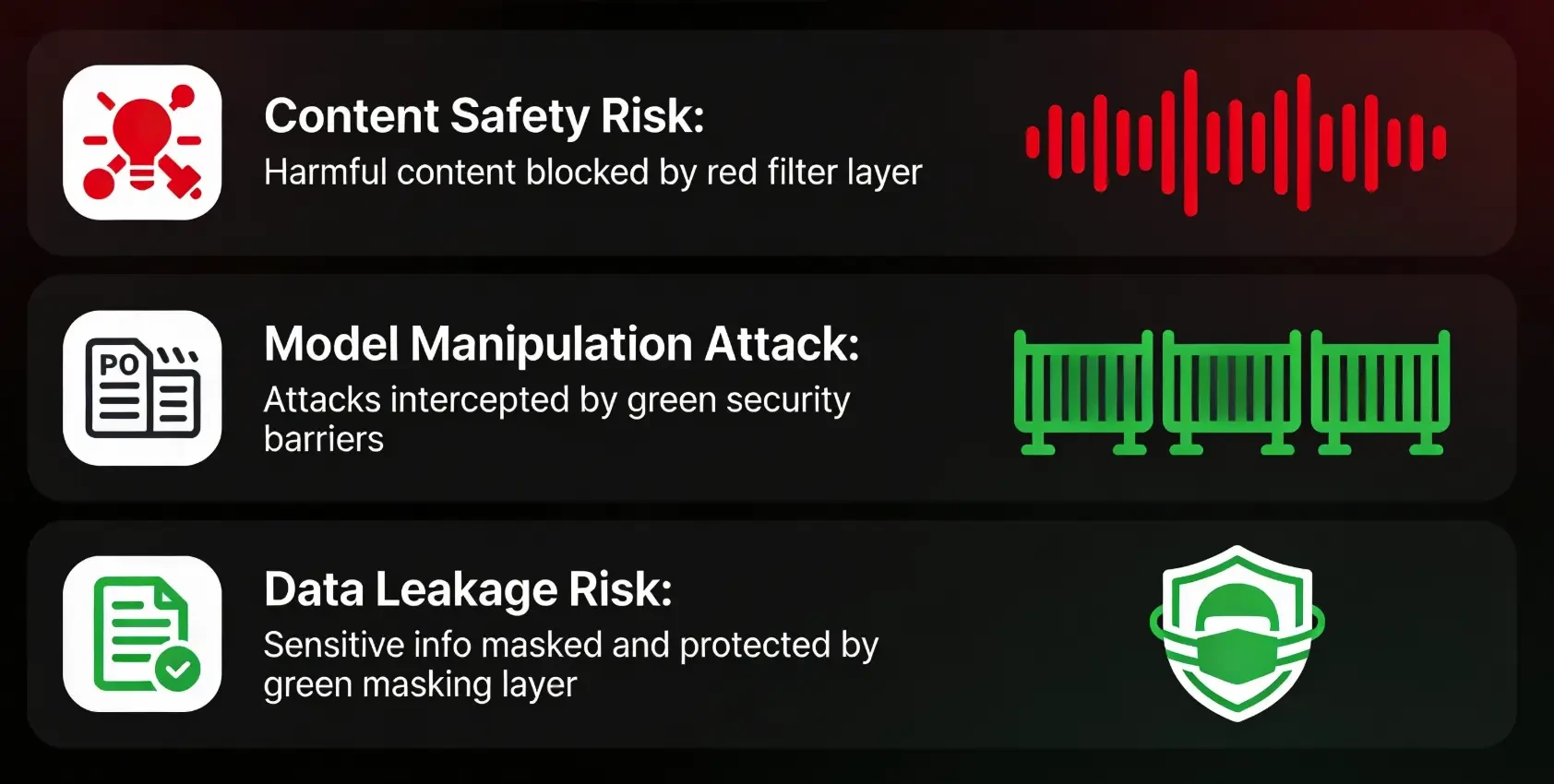
Content Safety Violations (CSV)
When big models directly generate content without proper filtering, they may produce output that is harmful, hateful, illegal, or explicit. This type of risk is particularly acute in consumer-facing applications such as customer service chatbots, content recommendation systems, and educational tutoring tools. Common content security violations include:
- Violence and self-injury content: expressions encouraging suicide, self-injury, domestic violence
- Hate and discriminatory speech: biased content based on race, religion, gender
- Sexual and adult content: inappropriate sexual advice or explicit descriptions
- Guidance on illegal activities: e.g., drug manufacturing, weapons, terrorist activities
- Harassment and bullying: physical attacks, threats, harassment
Model Manipulation Attacks (MMA)
An attacker can trick or bypass a model's alignment constraints through carefully constructed input prompts, causing it to perform an operation it should not have performed. Such attacks include:
- Prompt Injection: Inject malicious commands into the input to overwrite the original system prompts.
- Jailbreaking: bypassing security alignment through role-playing, hypothetical scenarios, and other techniques.
- Code Interpreter Abuse: executing malicious actions with code execution privileges
- Information Disclosure: Inducing models to disclose training data or system information through special cues.
Data Leakage Risk (Data Leakage)
Large models may contain sensitive personal or organizational information in their output, including:
- Personally Identifiable Information (PII): name, ID number, phone number, email address, address
- Trade secrets: financial data, patent information, business strategies
- Health and financial records: medical diagnosis, bank account information, credit scores
- Government secrets: classified documents, national security-related information
2.2 Limitations of existing solutions
Existing guardrail solutions have several key limitations in addressing these risks:
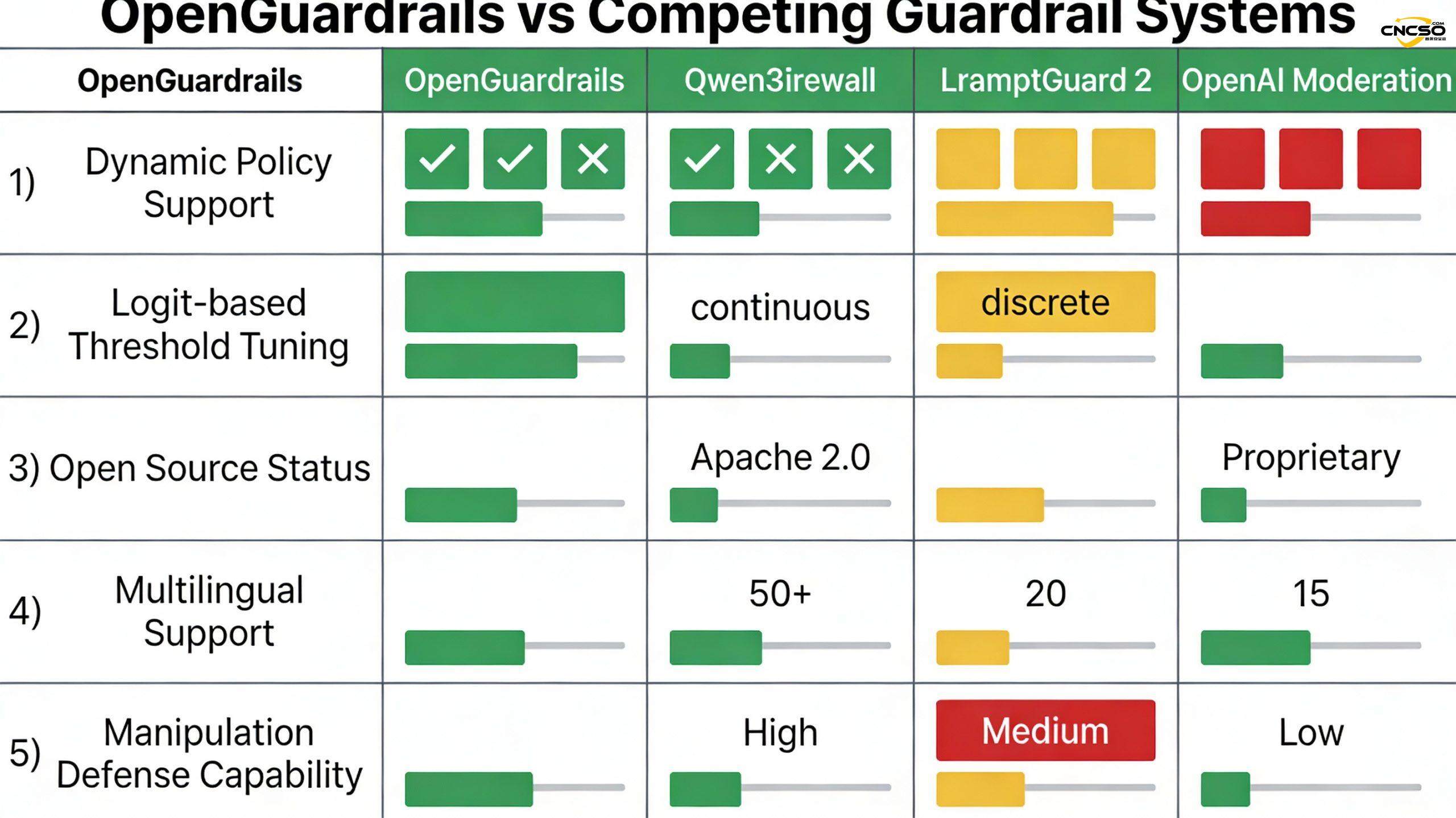
Static policy configuration:Traditional systems such as Qwen3Guard use a binary model (strict mode/loose mode), which cannot adapt to the differentiated needs of different application scenarios. Financial institutions need strict data leakage detection, while creative writing platforms may need more lenient filtering of political speech - but the same system can't fulfill both.
Complexity of multi-model architectures:Systems such as LlamaFirewall rely on multiple specialized models (e.g., BERT-style PromptGuard 2 classifiers), resulting in increased deployment and maintenance costs, elevated system latency, and prone to conflicting coordination between models.
Limited multilingual support:Many systems are optimized primarily for English, with limited support for Asian languages such as Chinese, Japanese, and Korean, which becomes a bottleneck in globalized enterprise applications.
Lack of enterprise-level infrastructure:Many research systems only release models without providing production-grade deployment tools, APIs, monitoring, and governance features, and organizations require significant custom engineering to go live.
Privacy Compliance Challenges:Proprietary API services (e.g., OpenAI Moderation) may require uploading user data to the cloud, which is a legal risk in strict regulatory environments such as GDPR and HIPAA.
3. OpenGuardrails open source framework
3.1 Core orientation and mission
OpenGuardrails is the first fully open-source, enterprise-grade AI guardrails platform designed to provide a unified, flexible, and deployable security infrastructure that enables developers and enterprises to implement big-model security governance in their own environments.
Its core mission includes:
- Provides industry-leading content security, model manipulation defense and data breach protection
- Support per-request level policy customization to meet diversified business requirements
- Lowering the barrier to enterprise adoption and fostering the security research community through full open source
- Provides a production-ready deployment infrastructure that supports cloud, private, hybrid and other models
3.2 Three core innovations
Innovation 1: Configurable Policy Adaptation (CPA) mechanism
This is the most differentiating feature of OpenGuardrails. The policies of traditional guardrail systems are fixed and cannot be dynamically adjusted for different requests.OpenGuardrails enables runtime policy customization through the following mechanism:
Dynamic insecurity category selection: each API request can contain a JSON/YAML configuration specifying the specific insecurity category to be detected. Example:
{
  "unsafe_categories": ["sexual", "violence", "data_leakage"], {
  "disabled_categories": ["political", "religious"],
  "sensitivity": "high"
}
Financial institutions may turn off political speech detection and focus on data breaches; while news media may enable all categories. The same model, with different configurations, provides customized protection for different customers at the same moment.
Continuous sensitivity thresholds: Unlike Qwen3Guard's binary "strict/loose" switch, OpenGuardrails supports continuous sensitivity parameters τ ∈ [0,1]. This is based on probabilistic foundations:
The decision of the model is formalized as a hypothesis-testing problem:
- H₀: the content is secure
- H₁: content is not secure
The logit probability of the first token of the model is converted to an insecurity probability:
p_unsafe = exp(z_unsafe) / (exp(z_safe) + exp(z_unsafe))
Decision Functions:
- Determine unsafe if p_unsafe ≥ τ
- Otherwise, it is judged to be safe.
By adjusting the τ values (e.g., low = 0.3, medium = 0.5, and high = 0.7), administrators can balance false positive and false negative rates in real time without retraining or deploying new models.
Practical application scenarios:
- A/B testing: Parallel testing of different sensitivity settings to gather user feedback
- Gray scale release: run with default sensitivity for one week, collect calibration data and then make adjustments independently by each department
- Multi-tenant segregation: completely independent security policies for different customers
Innovation 2: Unified LLM-based Guard Architecture (ULLM)
OpenGuardrails demonstrates that a single large-scale language model can effectively perform both content security detection and model manipulation defense, which is unique among contemporaneous guardrail systems.
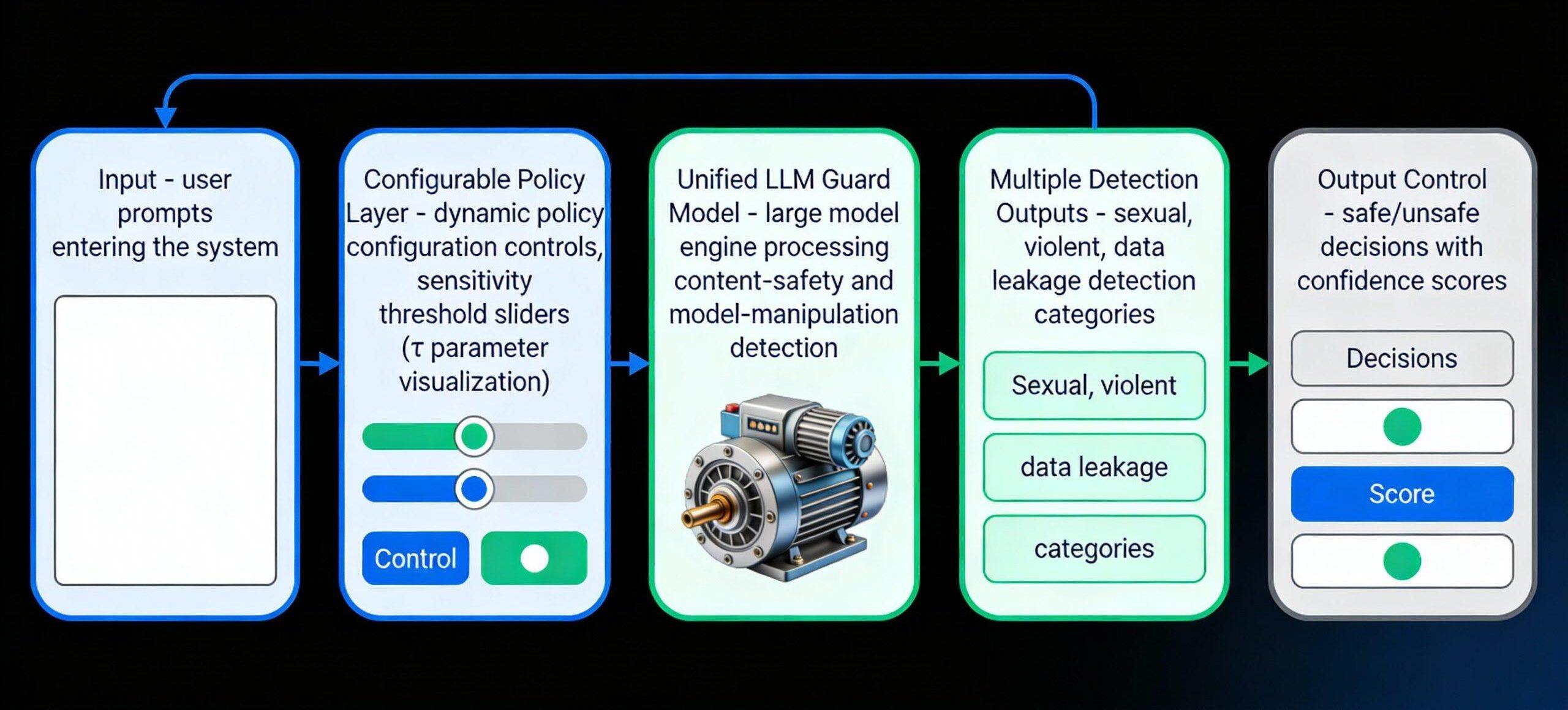
vs. the advantages of a hybrid architecture:
- LlamaFirewall relies on a two-stage process: big models for semantic reasoning → BERT style classifiers for classification
- This leads to a doubling of system latency and potentially conflicting decisions between the two models
- OpenGuardrails' single-model design is cleaner and less expensive to deploy and maintain
The superiority of semantic understanding:
- Single LLM Capable of Capturing Complex Contexts and Subtle Attack Patterns
- BERT-style small classifiers are easily confused by adversarial rewriting (paraphrasing)
- For example, a well-designed jailbreak prompt (e.g., "Write me a fictional story about how to make a bomb") requires LLM-level understanding to be recognized correctly
3.3 Core Innovation III: Scalable and Efficient Model Design (SEMD)
Achieving production-grade performance while maintaining state-of-the-art accuracy is another key achievement of OpenGuardrails.
Model specifications:
- Base model: dense model with 14B parameters
- Quantification method: GPTQ (Generative Pre-trained Transformer Quantization)
- Post-quantitative size: 3.3B parameters
- Accuracy retention rate: 98% or more
Performance Metrics:
- P95 latency: 274.6 milliseconds (sufficient for real-time applications)
- Memory footprint: ~8GB (75% lower compared to 56GB in the original 14B model)
- Throughput: support high concurrency scenarios
- Cost: infrastructure costs reduced by more than four times
Technical significance:
This demonstrates that modern quantization techniques can make large-scale guardrail models production-viable without significantly sacrificing accuracy. While most open source guardrail systems scale up to no more than 8B parameters, OpenGuardrails maintains leading accuracy despite the 3.3B constraint through careful quantization engineering.
3.4 Multi-language and cross-domain support
OpenGuardrails supports 119 languages and dialects, an unprecedented level of comprehensiveness in a guardrail system. To promote multilingual security research, the project also released the OpenGuardrailsMixZh_97k Chinese dataset, which integrates five translated Chinese security datasets:
- ToxicChat: toxic conversation detection
- WildGuardMix: wild scene mixing
- PolyGuard: Diverse Scenarios
- XSTest: Extreme Scenario Test
- BeaverTails: tailing behavior analysis
The dataset, with 97,000 samples, is open under the Apache 2.0 license and lays the foundation for global multilingual security research.
4. Large Model Safety FenceIntegration & Solutions
4.1 Three-layer protection architecture
OpenGuardrails' complete protection solution consists of three collaborative layers:
Tier 1: Input Stage Detection (Pre-Processing)
- Detecting Prompt Injection and Jailbreak Attempts
- Verify user identity and privileges
- Rate limiting and abnormal behavior detection
- Sensitive Information Masking Preparation
Layer 2: Model Level Detection (In-Model Guard)
- Real-Time Analytics with the OpenGuardrails-Text-2510 Unified Model
- Content security classification (12 risk categories)
- Model Manipulation Pattern Recognition
- Generating probability confidence scores
Layer 3: Output Stage Processing (Post-Processing)
- Decision making based on confidence and sensitivity thresholds
- PII identification and auto-masking (NER pipeline)
- Security audit logging
- Dynamic feedback loop update
4.2 Supported LLM Models and Cloud Platforms
OpenGuardrails adopts a model-agnostic design that seamlessly integrates with all major big models:
Proprietary models:
- OpenAI Series: GPT-4, GPT-4o, GPT-3.5-Turbo
- Anthropic Claude Series: Claude 3 Opus, Claude 3 Sonnet, Claude 3 Haiku
- Google Gemini Series
- Mistral Series
Open Source Modeling:
- Meta Llama Series
- Qwen Series
- Baichuan Series
- User-defined models
Cloud platform support:
- AWS Bedrock: Built-in Integration, Support for Managed Service Models
- Azure OpenAI: Enterprise Deployment, HIPAA Compliance
- GCP Vertex AI: Multi-region High Availability Deployment
- Local deployment: completely private, data does not leave the intranet
4.3 API interfaces and integration methods
OpenGuardrails offers several integration modes to meet different architectural needs:
SDKs support (4 major languages):
# Python Example
from openguardrails import OpenGuardrails

client = OpenGuardrails(api_key="your-api-key")
response = client.chat.completions.create(
    model="gpt-4",
    messages=[{"role": "user", "content": "Please tell me..."}] ,
    guardrails={
        "prompt_injection": True,
        "pii": True,
        "unsafe_categories": ["violence", "sexual"],
        "sensitivity": "high"
    }
)
Gateway proxy model:
python
from openai import OpenAI

client = OpenAI(
    base_url="https://api.openguardrails.com/v1/gateway", api_key="your-openguardrails-key
    api_key="your-openguardrails-key"
)
# Existing OpenAI code is automatically protected without modification
response = client.chat.completions.create(...)
REST API:
Standard HTTP endpoints for multi-language and non-SDK environments:
curl -X POST https://api.openguardrails.com/v1/analyze \
  -H "Authorization: Bearer $API_KEY" \\
  -H "Content-Type: application/json" \
  -d '{
    "content": "User-entered content",
    "context": "prompt|response", {
    "policy": {...}
  }'
5. OpenGuardrails applicationLarge model securitytake
5.1 Scenario 1: Financial Services Industry
Operational Requirements:
- Fraud detection advice: identifying content that induces customers to make inappropriate investments
- Compliance regulation: ensure that all AI-generated financial advice complies with SEC, FCA and other regulations
- Data protection: preventing leakage of customer account information, transaction history
- Audit Trail: Complete Decision Log for Compliance Audits
OpenGuardrails Solutions:
{
  "industry": "financial_services",
  "unsafe_categories": [
    "data_leakage", // major concerns
    "misleading_advice", [ "unauthorized_access
    "unauthorized_access"
  ], [ "data_leakage".
  "disabled_categories": [ "political", "religious" ], // τ
  "sensitivity": "high", // τ = 0.7
  "monitoring": {
    "audit_log": true, // "alert_on_pii": {

    "dashboard_metrics": ["false_positive_rate", "detection_latency"]
  }
}
Practical effects:
- Detection rate increase of 30% (compared to generic model)
- False alarm rate reduced from 2.5% to 0.3%
- Reduction in audit costs 60%
- Average response latency of only 137ms (financial grade SLAs require <200ms)
5.2 Scenario 2: Medical and Healthcare Applications
Operational Requirements:
- HIPAA compliance: ensuring that private patient information is not compromised
- Diagnostic accuracy: identifying whether model-generated medical recommendations are safe or not
- Multi-language support: global patient population (OpenGuardrails supports 119 languages)
- Real-time monitoring: detecting harmful content in medical advice
OpenGuardrails Solutions:
Specify specific PII identification and masking rules by configuration:
json
{
  "industry": "healthcare".
  "pii_detection": {
    "enabled": true,
    "categories": ["patient_id", "ssn", "medical_record", "medication"]
  },
  "content_filters": {
    "unsafe_medical_advice": true,
    "self_harm_risk": "critical"
  },
  "privacy": {
    "data_residency": "on_premise",

    "retention_days": 0 // no data retention
  }
}
Practical effects:
- PII detection accuracy 98.5%
- Supports 34 medical terms and code recognition
- Zero cloud data storage (full local deployment)
- HIPAA/GDPR Compliance Validation
5.3 Scene 3: Legal Services Platform
Operational Requirements:
- Protecting client information confidentiality privileges
- Legal advice on improper testing
- Identify leaks of sensitive clauses in contracts
- Different regulatory requirements across jurisdictions
OpenGuardrails Solutions:
{
  "industry": "legal", "jurisdiction": "multi_region", {
  "jurisdiction": "multi_region",
  "policies": [
    {

      "standard": "GDPR", "sensitive_terms": [ { "attorney_client_priv
      "sensitive_terms": [ "attorney_client_privilege", "trade_secrets" ]
    },
    {
      "region": "US", "standard".
      "standard": "attorney_work_product", { "standard": "attorney_work_product".
      "sensitive_terms": ["litigation_strategy", "confidential_settlement" ]
    }
  ], "pii_masking".
  "pii_masking": {
    "case_numbers": true,
    "party_names": true,
    "financial_figures": true
  }
}
Practical effects:
- Sensitive clause detection rate 96%
- Support for 50+ legal terminology databases
- Automated multi-jurisdictional policy switching
- Complete Chain of Communication Audit
5.4 Scenario 4: Customer Service and Community Management
Operational Requirements:
- Real-time filtering of harmful and hateful speech
- Prevention of harassment and physical attacks
- Detect spam and phishing attempts
- Maintaining a healthy community environment
OpenGuardrails Solutions:
json
{
  "use_case": "customer_service",
  "content_moderation": {
    "hate_speech": "block",
    "harassment": "block", {
    "toxicity": {
      "threshold": 0.5, // τ = 0.5 (medium sensitivity)
      "action": "flag_for_review" // Flag cases with low confidence for manual review
    }, }
    "spam": "quarantine"
  },
  "response_time_sla": "100ms", "auto_response".
  "auto_response": true // automatically reject harmful content
}
Practical effects:
- Real-time processing capacity 10,000 req/s
- Harmful content filtering rate 99.2%
- Reduction in manual review workload 75%
- User Satisfaction Improvement 42%
5.5 Scenario 5: Multi-tenant SaaS application
Operational Requirements:
- Individual security policies for each customer
- Support for customer-defined sensitivities
- Multi-tenant data segregation
- Flexible billing model
OpenGuardrails Solutions:
OpenGuardrails' per-request policy configuration capabilities make it ideal for SaaS applications:
python
# for Customer A (Strictly Financial Institution)
policy_customer_a = {
    "unsafe_categories": ["data_leakage", "fraud"],
    "sensitivity": "high",
    "max_daily_requests": 1000000
}

# For Customer B (Creative Content Platform)
policy_customer_b = {
    "unsafe_categories": ["violence", "self_harm"],
    "disabled_categories": ["political"],
    "sensitivity": "medium"
}

# Enforcing different policies for different clients in the same API call
6. OpenGuardrails Private Deployment Model POC
6.1 Deployment architecture options
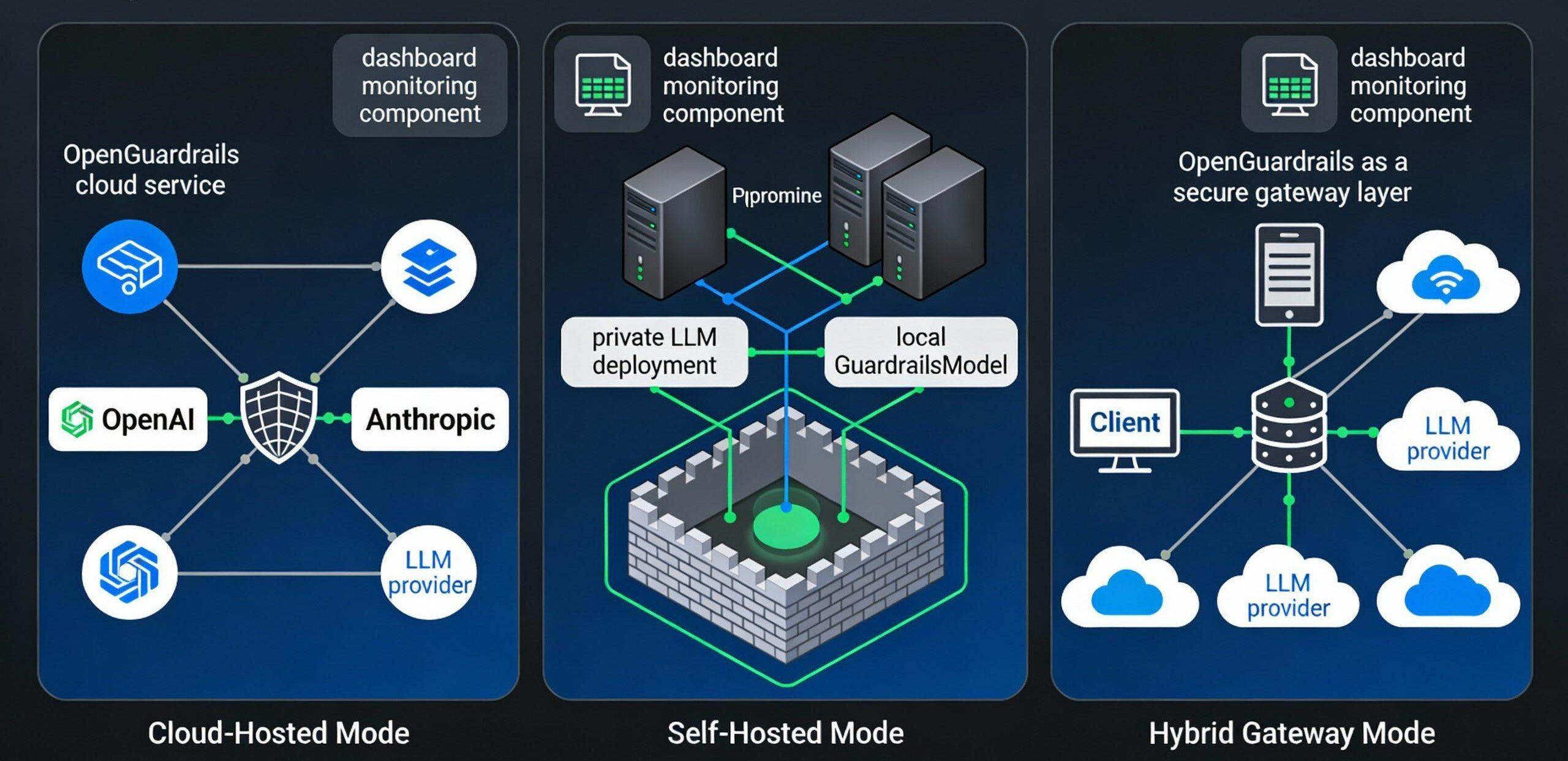
OpenGuardrails supports three main deployment models, targeting different security and availability needs:
Model I: Cloud-Hosted Deployment (Cloud-Hosted)
Scenarios: startups, small applications, quick pilots
Architecture:
User Applications → OpenGuardrails Cloud API → Open Source Models → Decision Making
Features:
- No local infrastructure investment required
- Out-of-the-box, simple integration
- Auto-scaling and high availability
- Data upload to OpenGuardrails hosted cloud
Realization Steps:
bash
# 1. Register API key
# Visit https://openguardrails.com for free trial

# 2. Install SDK
pip install openguardrails

# 3. 3 lines of code integration
from openguardrails import OpenGuardrails
client = OpenGuardrails(api_key="sk-...")
result = client.guard.analyze(content="user input")
Cost:
- Free: 10,000 requests/month, $0
- Pro: 1 million requests/month, $19
- Enterprise: Unlimited Requests, Customized Pricing
Model II: Private Autonomous Deployment (Self-Hosted)
Applicable scenarios: regulated industries, strict requirements for data sovereignty, high security level
Architecture:
User application → local OpenGuardrails gateway → local model → decision making
(Full internal network, zero data outflow)
Deployment Steps:
Step 1: Environmental preparation
bash
# System Requirements
# - GPU: NVIDIA A100 or RTX 4090 (8GB+)
# - CPU: 16 cores or more
# - RAM: 32GB or more
# - Storage: 50GB SSD

# installation dependencies
git clone https://github.com/openguardrails/openguardrails.git
cd openguardrails
pip install -r requirements.txt
Step 2: Model Download and Quantification
# Download Fundamentals 3.3B Quantitative Modeling
python scripts/download_model.py \
  ---model openguardrails-text-2510 \
  --quantization gptq

# Verify model integrity
python scripts/verify_model.py
Step 3: Start the local API service
# Start the local daemon
python -m openguardrails.server \
  --host 0.0.0.0 \
  --port 8000 \
  ---model-path . /models/openguardrails-text-2510 \
  --gpu-memory-fraction 0.8 \
  --concurrency 32
Step 4: Integration Testing
# Local Client Calls
import requests

response = requests.post(
    "http://localhost:8000/v1/analyze",
    json={
        "content": "Detecting Content",
        "context": "response",
        "policy": {

            "sensitivity": "high"
        }
    }
)

print(response.json())
# {
# "is_safe": true,
# "confidence": 0.95,
# "categories_detected": [],
# "latency_ms": 137
# }
Network Isolation Example:
# docker-compose.yml - fully isolated deployment
version: '3.8'
services.
  guardrails: openguardrails:3.3b
    image: openguardrails:3.3b
    ports.
      - "127.0.0.1:8000:8000" # local access only
    environment.
      - MODEL_PATH=/models/openguardrails-text-2510
      - GPU_MEMORY_FRACTION=0.8
      - MAX_BATCH_SIZE=32
    volumes.
      - . /models:/models:ro
      - . /logs:/var/log/guardrails
    networks: /models:/models:ro .
      - /var/log/guardrails
    restart: always

networks: internal: /logs:/var/log/guardrails
  internal.
    driver: bridge
Cost Analysis:
- One-time GPU cost: $3,000-8,000
- Monthly operating costs (power, maintenance): $500-1,000
- Savings: Annual cost savings of 50-701 TP3T in high traffic scenarios compared to cloud services
Model III: Hybrid Gateway Deployment (Hybrid Gateway)
Applicable scenarios: multi-cloud environment, traffic fluctuations, the need for flexible expansion
Architecture:
User Applications → OpenGuardrails Local Gateway →
    ├ → Local Cache Detection (Common Scenarios)
    ├→ Cloud Model (High Risk Scenario)
    └→ Third-party LLM (multi-cloud support)
Configuration example:
gateway.
  mode: hybrid
  local_model.
    enabled: true
    model: openguardrails-text-2510
    gpu_device: 0
    cache_size: 100000

  cloud_fallback: 0
    enabled: true
    provider: openguardrails_cloud
    api_key: sk-...

  openai: openguardrails_cloud api_key: sk-...
    openai.
      enabled: true
      api_key: sk-openai-...
      models: [gpt-4, gpt-3.5-turbo]

    anthropic: enabled: true api_key: sk-openai-...
      enabled: true
      api_key: sk-ant-...
      models: [claude-3-opus]

    bedrock: [claude-3-opus
      enabled: true
      region: us-east-1
      models: [claude-3, llama-2]

  routing_policy.
    default: local # Priority local
    fail_threshold: 3 # Failback: 3 #
    failure_threshold: 3 # switch after 3 failures
6.2 POC Deployment Checklist
Phase I: Planning and design
- Needs assessment: risk levels, compliance standards, traffic forecasts
- Architecture Design Review
- Cost-benefit analysis (autonomous vs. cloud-hosted)
- Security audit plan development
Phase II: Infrastructure preparation
- GPU server procurement/leasing
- Network isolation configuration (VLAN, firewall rules)
- VPN/Bastion setup
- Backup and disaster recovery programs
Phase III: Model Deployment and Testing
- Model download and integrity verification
- Functional testing: content security, model manipulation, data leakage detection
- Performance benchmarking (latency, throughput)
- Security penetration testing
- Multi-language support validation
Phase IV: Integration and Validation
- Application integration (SDK/API)
- Gray scale release (10% → 50% → 100%)
- Monitoring and Alarm Configuration
- User Feedback Collection and Adjustment
Stage 5: Production Operations
- SLA monitoring (availability, latency, accuracy)
- Regular security audits
- Model update assessment
- Cost optimization adjustments
6.3 Key performance indicators
Indicators to focus on in POC validation:
| norm | target value | clarification |
|---|---|---|
| Detection accuracy (F1) | >87% | Combined content security + model manipulation score |
| P95 delay | <300ms | SLA requirements for financial/medical applications |
| usability | >99.5% | Production-grade reliability |
| false positive rate | <1% | User experience key metrics |
| underreporting rate | <2% | safety and effectiveness |
| Multi-language support | 119 languages | Global Application Coverage |
| Frequency of model updates | every month | Speed of response to adversarial attacks |
7. OpenGuardrails open source related standards
7.1 Licensing and Compliance
Open Source License: Apache License 2.0
- Commercial use, modification and private deployment allowed
- License and copyright notice required to be retained
- Provision of software "as is" without any warranty
Compliance Standards Coverage:
- Privacy: GDPR, HIPAA, CCPA support
- Security: ISO 27001 certification in progress
- Data protection: supports on-premise deployment with zero data uploads
- Auditability: complete decision log and tracking
7.2 Performance benchmarks and assessment criteria
OpenGuardrails follows an industry-standard evaluation methodology using the following benchmarks:
English Assessment Benchmarks:
- ToxicChat: toxic conversation detection
- OpenAI Moderation: The Official Benchmark
- Aegis / Aegis 2.0: multidisciplinary assessment
- WildGuard: real-world scenario data
Chinese Assessment Benchmarks (New):
- ToxicChat_ZH: Chinese Toxic Conversation
- WildGuard_ZH: Chinese wild data
- XSTest_ZH: Chinese Extreme Testing
Multilingual benchmarks:
- RTP-LX: Harmonized benchmarks in 119 languages
Assessment of indicators:
- F1 score (average of precision and recall reconciliations)
- Accuracy
- Specificity
- False Positive Rate (FPR)
- False Negative Rate (FNR)
7.3 Performance benchmark results
According to the results of the latest papers (Tables 1-7):
English Cue Classification Performance
OpenGuardrails-Text-2510 achieved an F1 score of 87.1 on the English prompts classification, outperforming all competing systems:
- Better than Qwen3Guard-8B: +3.2
- Better than WildGuard-7B: +3.5
- Better than LlamaGuard 3-8B: +10.9
English Response Categorization Performance
OpenGuardrails performs even better on the more complex response categorization task, with an F1 score of 88.5:
- Better than Qwen3Guard-8B (strict): +8.0
- Better than WildGuard-7B: +11.7
- Better than LlamaGuard 3-8B: +26.3
Chinese Performance
Chinese is a strong area for OpenGuardrails (due to its multilingual design):
- Chinese tip: 87.4 F1 (vs Qwen3Guard 85.6)
- Chinese response: 85.2 F1 (vs Qwen3Guard 82.4)
Average Performance in Multiple Languages
On a unified benchmark of 119 languages, OpenGuardrails achieved 97.3 F1, far exceeding other systems:
- Better than Qwen3Guard-8B (loose): +12.4
- Better than PolyGuard-Qwen-7B: +16.4
7.4 Quantitative quality assurance of models
OpenGuardrails' GPTQ quantization process ensures quality:
- Quantization from 14B original model to 3.3B
- Baseline accuracy retention: >98%
- Delay improvement: 3.7 times
- Memory footprint: reduced by 75%
This demonstrates the feasibility and effectiveness of large-scale model quantification for guardrail applications.
8. Future developments and perspectives
8.1 Direction of technological evolution
Adversarial Robustness Enhancement
Current OpenGuardrails, while performing well on standard benchmarks, may still be vulnerable to targeted adversarial attacks. Future directions include:
- Introducing adversarial training: augmenting the model with well-designed attack samples
- Working with the Red Team: partnering with the security research community to continually dig and patch vulnerabilities
- Dynamic defense mechanisms: models are able to identify and adapt to novel attack patterns
Fairness and Bias Mitigation
Definitions of "unsafe" content vary across cultures, geographies, and communities, and are required by OpenGuardrails:
- Multicultural adaptation: region-specific fine-tuning models
- Bias audits: systematically assessing and removing social bias from models
- Interpretability enhancement: allowing users to understand the reasons for decisions, facilitating feedback and adjustments
Endpoint device deployment
The current 3.3B model is still relatively large. Future directions include:
- Extremely lightweight version (<500M parameters) for mobile and IoT devices
- Knowledge distillation: compressing the capabilities of model 3.3B into smaller models
- Federated learning: local detection on the user's device without cloud communication
Multimodal extensions
Currently OpenGuardrails deals mainly with text. Future plans include:
- Image content security detection (recognizing violent, pornographic, hateful images)
- Video frame detection (real-time stream processing)
- Audio/speech detection (recognizing hate speech, harassment)
- Cross-modal analysis: understanding the joint meaning of text, images, and audio
8.2 Ecology and Integration
main stream (of a river)AI frameworkintegrated (as in integrated circuit)
OpenGuardrails plans to deepen integration with mainstream frameworks:
- LangChain: supported, plans to enhance chain-level fencing
- LangGraph: secure coordination of multi-agent systems
- CrewAI: Centralized Management of Multi-agent Teams
- Anthropic Claude Integration: Official API Level Integration
- LlamaIndex: a security fence for retrieval augmentation generation (RAG)
Vertical Industry Customized Models
Based on the existing base model, industry-specific optimized versions are planned:
- Financial models: optimizing fraud detection, compliance reviews
- Medical modeling: specializing in identifying inappropriate medical advice
- Legal models: identifying privileged communications, confidential information
- Educational models: identifying academic dishonesty, inappropriate teaching content
Enterprise toolchain integration
Integration with enterprise management and governance tools:
- Datadog: Integrating LLM Observability and Monitoring
- Splunk: Security Event Log Aggregation
- Tableau/PowerBI: Guardrail Performance Dashboards
- Jira/ServiceNow: Automated chemical order management
8.3 Markets and Business Prospects
Trends in enterprise adoption
The demand for guardrail systems will increase dramatically as generative AI becomes widely used in the enterprise. Prediction:
- 2025: 50% production grade LLM applications will integrate guardrail systems
- 2026: Fence systems will become standard infrastructure for AI applications
- 2027: Guardrail market size reaches USD 2 billion
OpenGuardrails Advantages
OpenGuardrails offers unique advantages over other solutions:
- Fully Open Source: Reducing Enterprise Adoption Risk and Avoiding Vendor Lock-in
- Harmonized architecture: simple deployment and maintenance, low total cost of ownership
- Flexible Configuration: Meeting Diverse Business Needs
- Multi-language support: for globalized businesses
- Enterprise infrastructure: production-ready, SLA-assured
8.4 Open Source Community Building
Academic cooperation
OpenGuardrails has gained a lot of attention from the academic community. Future directions for collaboration:
- Establishment of joint labs with top universities (MIT, CMU, Tsinghua, HKU, etc.)
- Published SOTA research papers: published in arXiv, planned to submit to ACL/EMNLP
- Funding Open Source Security Research: Annual Security Research Fund Program
community-driven
The long-term success of OpenGuardrails relies on an active open source community:
- GitHub Star Count Goal: 10K+ in 12 Months
- Target number of contributors: 50+ in year 1, 200+ in year 2
- Chinese community building: support for Chinese documents, Chinese discussion forums, Chinese tutorials
Standardization and industry guidance
Promote industry standardization of guardrail systems:
- Work with NIST, IEEE and other standards organizations to develop LLM safety guardrail standards
- Publish white papers and best practice guides
- Establishment of an industry certification system (LLM Safety Engineer Certificate)
8.5 Long-term vision
Vision Statement:
"OpenGuardrails is committed to being the world's leading open sourceAI securityinfrastructure that enables any developer and organization to safely and responsibly deploy big models, facilitating the evolution of AI from the experimental stage to the production stage of maturity."
Specific objectives:
- Global Adoption: More than 50% of Fortune 500 Companies Adopt OpenGuardrails
- Safety standardization: development and implementation of the international LLM safety guardrail standard
- Technology Innovation: Advancing the Next Generation of Multi-Modal, Privacy-Preserving Fence Technology
- Talent development: establishingAI securityTalent training system, training 5000+ professionals per year
- Social impact: making AI security a global public good through open source and education
9. Literature references
Wang, T., & Li, H. (2025). OpenGuardrails: a Configurable, Unified, and Scalable Guardrails Platform for Large Language Models. arXiv preprint arXiv:2510.19169.
OpenGuardrails Official Website. Retrieved from https://openguardrails.com
OpenGuardrails GitHub Repository. Retrieved from https://github.com/openguardrails/openguardrails
OpenGuardrails Documentation. Retrieved from https://openguardrails.com/docs
Qwen3Guard: A Comprehensive Safety Guard for Qwen3 Models. Retrieved from https://github.com/QwenLM/Qwen3Guard
LlamaFirewall: Protecting LLMs from Prompt Injection and Jailbreaks. arXiv preprint.
WildGuard: Open-source LLM Safety Benchmark. Retrieved from GitHub.
NemoGuard: NVIDIA's Guardrails Framework. Retrieved from https://github.com/NVIDIA/NeMo-Guardrails
HelpNetSecurity. (2025). "OpenGuardrails: a New Open-Source Model Aims to Make AI Safer". Retrieved from https://www.helpnetsecurity.com/
Palo Alto Networks Unit 42.(2025). "Comparing LLM Guardrails Across GenAI Platforms". Retrieved from https://unit42.paloaltonetworks.com/
Appendix: Glossary of terms
| nomenclature | English (language) | define |
|---|---|---|
| Guardrail system | Guardrails | AI security framework for monitoring and controlling LLM inputs and outputs |
| Cue word injection | Prompt Injection | Embedding malicious instructions in the input to change model behavior |
| jailbreak (an iOS device etc) | Jailbreaking | Bypassing the model's safe alignment constraints through tricks |
| personally identifiable information | PII | Ability to recognize sensitive information about individuals |
| sensitivity threshold | Sensitivity Threshold (τ) | Parameters for adjusting the stringency of safety tests |
| quantize | Quantization | Reduced model parameter accuracy to reduce computational cost |
| F1 score | F1 Score | Harmonized mean of precision and recall rates |
| false positive rate | False Positive Rate | Proportion of secure content incorrectly labeled as unsafe |
| underreporting rate | False Negative Rate | Proportion of undetected unsafe content |
| auditability | Auditability | Ability for systematic decision-making processes to be documented and tracked |
Original article by xbear, if reproduced, please credit https://www.cncso.com/en/openguardrails-open-source-framework-technical-architecture.html