Vulnerability analysis
-
AI Assistant Security: OpenClaw One-Click Remote Code Execution Vulnerability
In early 2026, OpenClaw, an open source AI agent (Agent), was exposed to a high-risk One-Click Remote Code Execution (One-Click RCE) vulnerability (CVE-2026-25253). The vulnerability stems from a design flaw in its Control UI, which allows an attacker to steal authentication tokens with elevated privileges by tricking a user into clicking on a well-constructed malicious link, and ultimately execute arbitrary code on the victim's device. In this paper, we will analyze the principle of the vulnerability, the attack chain, the exploitation code (POC/EXP), and provide the corresponding fixes.
-
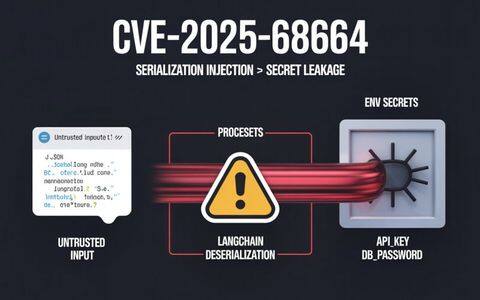
CVE-2025-68664 : Serialized Injection Vulnerability Report for LangChain, an Open Source Framework for Large Models
LangChain, a large open source model, has disclosed a severity-level serialization injection vulnerability (CVE-2025-68664), discovered by Yarden Porat, a security researcher at Cyata Security, in which the "lc" key is missing in the serialization/deserialization process. This vulnerability, discovered by Cyata Security security researcher Yarden Porat, is caused by a missing "lc" key in the serialization/deserialization process, which allows an attacker to leak environment variables, instantiate arbitrary objects, or even remotely execute code by means of prompt injection. The vulnerability affects all deployments of LangChain Core before version 0.3.81 and within the range of versions 1.0.0-1.2.5. Officials have released patch versions 1.2.5 and 0.3.81 on December 24th and tightened the default security policy simultaneously.
-
AI Intelligence Body Security: GitHub Actions Prompt Word Injection (PromptPwnd) Vulnerability
PromptPwnd is a new type of vulnerability discovered by the Aikido Security research team that poses a serious threat to GitHub Actions and GitLab CI/CD pipelines that integrate AI agents. The vulnerability utilizes Prompt Injection to cause key compromise, workflow manipulation, and supply chain compromise by injecting malicious commands into an AI model, causing it to perform high-privilege operations. At least five Fortune 500 companies have been affected, and several high-profile projects such as the Google Gemini CLI have been verified to have the vulnerability.
-
CVE-2025-34291: Langflow AI Intelligence Body and Workflow Platform Account Takeover and Remote Code Execution Vulnerability
CVE-2025-34291 is a critical vulnerability chain found in the Langflow AI Agent and Workflow Platform with a security score of CVSS v4.0: 9.4. The vulnerability allows an attacker to achieve full account takeover and remote code execution (RCE) of Langflow instances by inducing users to visit a malicious web page.
-
CVE-2025-55182: React Server Components Remote Code Execution Vulnerability
CVE-2025-55182 Vulnerability Introduced by React 19 in the affected version, Next.js App Router takes RSC serialized data from the client and passes it directly to ReactFlightReplyServer to deserialize it, without sufficiently checking the model structure, reference paths and Server Reference metadata. An attacker can construct a malicious RSC. An attacker can construct a malicious RSC request, guide parseModelString, getOutlinedModel, loadServerReference, initializeModelChunk, and other parsing links into an exception state, and control the target of the call during the module loading and reference binding phases, and ultimately trigger an arbitrary server-side trigger in Next. js. js can trigger any server-side code execution.
-
Revealing Third-Party SDK Vulnerabilities: A Practical Guide to Mobile APP Application Security Attack and Defense
This article introduces the actual vulnerability mining of mobile APP third-party SDK conducted by security researchers Li Bo and Zhang Xin of 360 Vulpecker Team. 360 Vulpecker Team focuses on the field of Android system and application security attack and defense, and has a self-developed automated system for Android application security auditing. This article starts from the security status of third-party SDKs, discusses the security risks brought by SDK integration, and introduces in detail the vulnerability risks and attack methods of different SDKs. The vulnerability exploitation methods of push SDK and sharing SDK are analyzed through examples, and the scope of impact of relevant vulnerabilities on applications is pointed out. Finally, some thoughts are put forward to arouse readers' attention and in-depth thinking on the security of mobile APPs.
-
Google Android 14 input method information leakage vulnerability and impact
Google Android 14 input method information disclosure vulnerability, due to side channel information leakage, there is a possible way to determine whether an application is installed without querying permissions. This may lead to local information disclosure without requiring additional execution permissions. Exploitation of this vulnerability requires no user interaction.
-
[Critical] Remote code execution vulnerability in open source Apache Log4j
On November 24, 2021, the Alibaba Cloud security team reported the Apache Log4j2 remote code execution vulnerability to Apache officials. 01 Vulnerability Description Apache Log4j2 is an excellent Java logging framework. …






![[Critical] Remote code execution vulnerability in open source Apache Log4j](https://static.cncso.com/wp-content/uploads/2021/12/log4j.jpeg?x-oss-process=image/resize,m_fill,w_480,h_300,limit_0)